HoneyPower Official Website › Blog › The Medicine Cabinet
The Medicine Cabinet: What Prescriptions Do To Erections
Before crediting a capsule for a good month, or blaming yourself for a bad one, it is worth looking at what else is in the bathroom cabinet. Several common prescriptions have been tested for effects on erectile function, and the results are more interesting, and more reassuring, than the folklore. Some drugs do carry a real signal. Others turn out to be blamed unfairly. And one trial showed that simply being told about a side effect can produce it.
- A review of 41 randomised trials found antidepressants were associated with higher odds of erectile dysfunction than placebo (odds ratio 2.28) and of ejaculatory problems (odds ratio 7.31). Serotonin and noradrenaline reuptake inhibitors, not SSRIs, carried the erectile signal.
- Among blood pressure drugs, beta-blockers are still the class most often linked to erectile difficulty, but a network meta-analysis found no significant effect for any major class against placebo.
- A meta-analysis of 15 hair-loss trials found 5-alpha-reductase inhibitors carried a 1.57-fold risk of sexual dysfunction.
- In a 96-man trial of atenolol, erectile problems were reported by 3.1 percent of men who were blinded to the drug and 31.2 percent of men who had been told about the side effect, and placebo worked as well as sildenafil in the men affected.
- Nothing here is a reason to stop a prescribed medicine. It is a reason to have the conversation.
Why the medicine cabinet comes first
A man who notices a change in erectile function and reaches for a supplement is making a reasonable-looking move that skips a step. The step is the list of things he already takes. Medicines are a recognised contributor, which is why every review cited below exists, and the timing is often a giveaway. A change that started within weeks of a new prescription has an obvious first suspect that no capsule addresses.
There is a second reason to look. If you start a supplement while a medicine is quietly doing something to the same outcome, you cannot credit or blame the capsule. That is the same attribution problem the article on the placebo response discusses, arriving from a different direction.
This article does not tell anyone to stop, change or avoid a medicine. Every drug below is prescribed for a reason, and the risk of an untreated condition usually outweighs the risk of a side effect that can be discussed and managed. The point is only to describe what the controlled evidence shows, class by class, so the conversation with a prescriber can start from the numbers.
Antidepressants and antipsychotics
The most systematic look at psychiatric medicines is by Trinchieri and colleagues, who reviewed randomised trials of psychotropic drugs against placebo or against another drug of the same class, lasting at least five weeks, and limited to studies where the results for men could be analysed separately. They included 41 studies.
For antidepressants against placebo, the pooled results were:
| Outcome | Odds ratio versus placebo | Trials and men |
|---|---|---|
| Decreased libido | 1.89 (95% CI 1.40 to 2.56) | 11 trials, 7,706 participants |
| Erectile dysfunction | 2.28 (95% CI 1.31 to 3.97) | 11 trials, 3,008 participants |
| Ejaculatory dysfunction | 7.31 (95% CI 4.38 to 12.20) | 19 trials, 3,973 participants |
From the review's abstract. An odds ratio above 1 means the outcome was more likely on the drug than on placebo.
A detail that surprises people: when the authors separated the classes, the higher odds of erectile dysfunction were significant for the serotonin and noradrenaline reuptake inhibitors and not for the SSRIs. For antipsychotics, the data were more limited. The authors noted that aripiprazole showed lower odds for erectile problems than other atypical antipsychotics and risperidone higher odds for ejaculatory problems, and that the prolactin rise associated with first-generation drugs and with risperidone seemed to play a primary role.
The summary the authors drew was that most antidepressants cause decreased libido, ejaculatory dysfunction and erectile dysfunction, and that a clinician managing these problems needs to know which drug is involved, because the mechanisms differ.
Mood is also a story of its own. The article on anxiety, depression and erections covers what the condition itself does, separate from any treatment. A man on an antidepressant is therefore in an awkward spot, with the illness and its treatment both able to affect the outcome, which is a strong argument for raising it with the prescriber rather than solving it alone.
Blood pressure tablets, class by class
Blood pressure medicines have carried a reputation for causing erectile problems for decades, and the reputation is only partly earned. Two recent papers sort the classes.
Corona and colleagues reviewed the evidence in 2025 and reached a graded conclusion. The negative role of centrally acting drugs such as clonidine and alpha-methyldopa is well documented, although few controlled trials exist. ACE inhibitors, angiotensin receptor blockers and calcium channel blockers have neutral effects (the calcium channel blockers) or even positive ones (ACE inhibitors and ARBs) on erectile function. Despite some preliminary negative reports, more recent evidence does not confirm a negative impact of thiazides. Beta-blockers, the authors write, should still be considered the class most often associated with erectile dysfunction, although better outcomes can be drawn with nebivolol. They recommend that sexual function be assessed in every patient with high blood pressure, at diagnosis or after a new prescription.
Farmakis and colleagues took a stricter statistical approach with a network meta-analysis of randomised trials of five drug classes in people with or at high risk of cardiovascular disease. They included 25 studies with 7,784 patients, 16 of which went into the quantitative synthesis. No significant differences in erectile function were found between the classes. With placebo as the reference, no strategy produced a significant effect either. Nebivolol looked better than non-vasodilating beta-blockers (odds ratio 2.92) but not better than placebo (odds ratio 2.87 with a confidence interval running from 0.75 to 11.04). The authors concluded that all classes seem to have neutral or insignificant effects, while flagging that the risk of bias was concerning or high in most of the studies and that inconsistency was high.
So there are two honest readings and both belong in the room. One is that beta-blockers remain the class clinicians watch most closely. The other is that the trial data, taken as a whole, do not show a clear class effect for most blood pressure drugs. The conflict is real, and it is why the answer for a particular man is a conversation and not a rule.
Drugs taken for hair loss
A different class deserves a paragraph because it is bought for cosmetic reasons by men who may not think of it as a medicine at all. Lee and colleagues pooled 15 double-blind placebo-controlled trials with 4,495 subjects on finasteride 1 mg a day or dutasteride 0.5 mg a day for male androgenetic alopecia. Use of 5-alpha-reductase inhibitors carried a 1.57-fold risk of sexual dysfunction (95 percent confidence interval 1.19 to 2.08). Finasteride on its own was 1.66 (1.20 to 2.30). Dutasteride was 1.37 (0.81 to 2.32), which was not statistically significant, although the authors noted that few dutasteride studies existed and more trials were needed.
The abstract's careful summary is that the risk of adverse sexual effects has been controversial, that treatment is efficacious, and that physicians should be aware of and assess the possibility. That is an even-handed way to put it. Neither drug is presented as a villain and neither is presented as harmless.
Read the interaction notes before the first capsule
Two of the six named ingredients carry documented interactions with prescription medicines. The side effects page sets both out, and the guidance is the same for every prescription: raise it first.
One bottle $69 · six bottles $294 · 180-day money-back guarantee
Order HoneyPower On The Official WebsiteTwo capsules a day · 60 per bottle · lot HON-26/MY-5579
The trial where knowing was the side effect
The most striking study in this whole area is a small, old and ingenious one. Silvestri and colleagues wanted to know whether the reported link between beta-blockers and erectile problems was in part a matter of what patients had been told. They recruited 96 men, average age 52, with newly diagnosed cardiovascular disease and no erectile dysfunction at the start, and gave all of them the beta-blocker atenolol at 50 mg once daily.
The men were split into three groups of 32. Group A was blinded to what they were taking. Group B was told the name of the drug but not its side effects. Group C was told the drug and was also informed about its effect on erectile function. After three months the incidence of erectile dysfunction was:
| Group | What the men knew | Erectile dysfunction at 3 months |
|---|---|---|
| A (32 men) | Blinded to the drug | 3.1% |
| B (32 men) | Told the drug, not its side effects | 15.6% |
| C (32 men) | Told the drug and its sexual side effects | 31.2% |
From the trial's abstract; the difference across the groups was significant (P below 0.01).
Then came the second phase. Every man who reported erectile problems was randomised, in a crossover design, to sildenafil 50 mg or to placebo. The abstract reports that sildenafil and placebo were equally effective in reversing the problem in all but one patient. The authors concluded that knowledge and prejudice about side effects of beta-blockers can produce anxiety, and that anxiety may cause erectile dysfunction.
It would be a mistake to read this as saying the drug does nothing. The blinded group still had a low rate, and the whole trial is about how much of the reported effect is expectation. But it is a direct demonstration that the nocebo effect described in the placebo article is not a theoretical curiosity. Being told what might happen made it far more likely to be reported, and a dummy pill fixed it.
There is a practical consequence that cuts the other way too. If you read a long list of possible side effects and then notice one, some of what you notice may be the reading. That is a reason to talk to the prescriber about a change rather than to stop the drug on your own.
Where the capsule comes into it
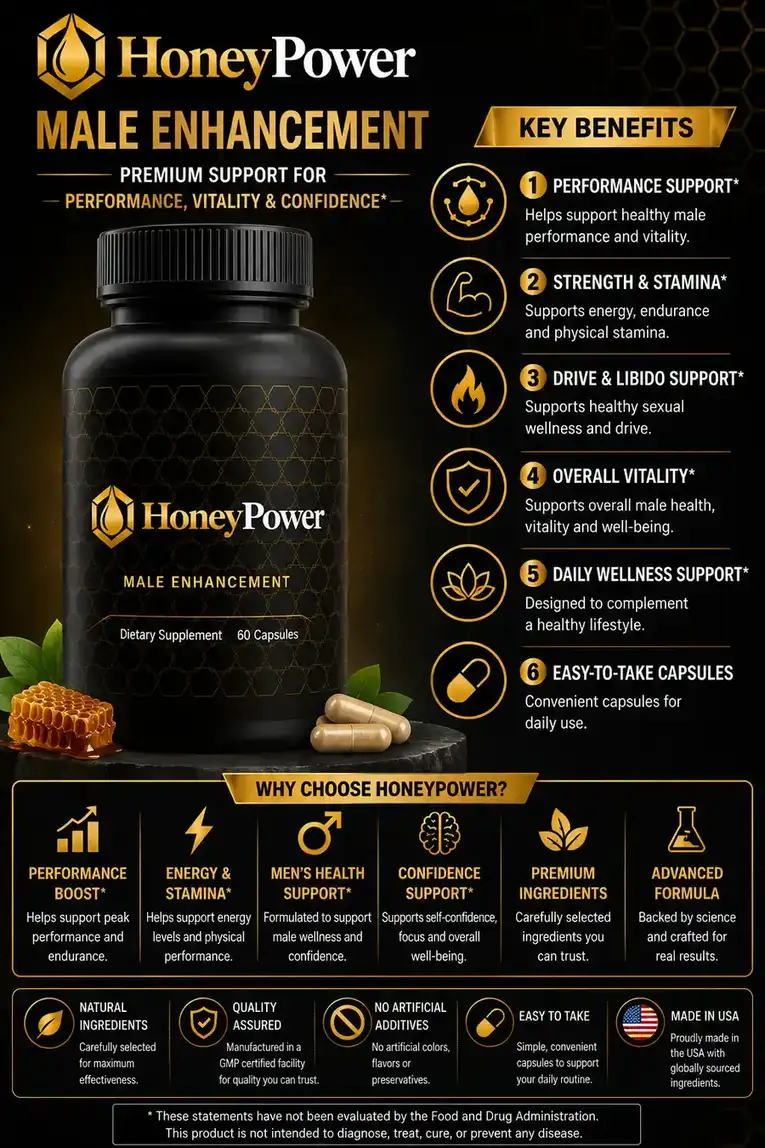
HoneyPower is a dietary supplement with six named ingredients, and no amount is printed for any of them. Two of the six carry documented interactions, and the side effects page sets both out in full: ginseng with warfarin, and piperine, the active constituent of the black pepper extract, with medicines cleared by particular liver enzymes and transporters. The article on piperine covers the second, and the ginseng article covers the first. This article adds a broader point rather than a new interaction.
The broader point is that a capsule added to a medicine cabinet has two separate jobs for a prescriber to think about. It could interact with something on the list, which is a pharmacological question. And it can muddy attribution, because if erectile function changes after you add it, neither you nor the prescriber can tell whether it was the capsule, the drug, the season or the placebo response. Bringing the list to the appointment, supplements included, solves both.
The seller's disclaimer, repeated on every page of this website, says to talk to a doctor before use if you take any medicine. This desk agrees, and the how to use page describes the practical side, including the timing question for anyone on a prescription.
How to have the conversation
- Make a complete list. Prescriptions, over-the-counter products, vitamins, botanicals and anything you are thinking of buying. Take the bottles, or photographs of them.
- Say when it started. The order of events matters more than the details. If the change began within weeks of a new prescription, say so first.
- Ask about alternatives, not permission to stop. Within most classes there are options. The 2025 review above notes that better outcomes can be drawn with nebivolol among beta-blockers, which is exactly the sort of class-level nuance a prescriber can act on.
- Do not stop a medicine on your own. An untreated blood pressure or mood problem is the larger risk, and the trials above are about groups, not about you.
- Ask what they would want to know if you added a supplement. The answer is usually short and specific.
Four questions worth asking your prescriber
- Is any of my current medication known to affect erections, and by how much in the trials?
- Did the change start within weeks of a dose change or a new drug?
- Is there an equivalent in the same class with a different profile?
- If I add a herbal supplement with several ingredients, is there anything on my list it could interact with?
Several common medicines have been tested for effects on erectile function. Antidepressants carry a clear signal, beta-blockers remain the most watched blood pressure class though the pooled trial data are neutral, and 5-alpha-reductase inhibitors carry a 1.57-fold risk of sexual dysfunction in hair-loss trials. In one trial, telling men about a side effect raised the reported rate from 3.1 to 31.2 percent. Take the whole list to the appointment, including the capsule, and do not stop a prescription on the strength of an article.
References
- Corona G, Vena W, Pizzocaro A, Salvio G, Sparano C, Sforza A, et al. Anti-hypertensive medications and erectile dysfunction: focus on β-blockers. Endocrine. 2025;87(1):11-26. PMID 39269577. https://pubmed.ncbi.nlm.nih.gov/39269577/
- Farmakis IT, Pyrgidis N, Doundoulakis I, Mykoniatis I, Akrivos E, Giannakoulas G. Effects of Major Antihypertensive Drug Classes on Erectile Function: a Network Meta-analysis. Cardiovasc Drugs Ther. 2022;36(5):903-914. PMID 33945044. https://pubmed.ncbi.nlm.nih.gov/33945044/
- Lee S, Lee YB, Choe SJ, Lee WS. Adverse Sexual Effects of Treatment with Finasteride or Dutasteride for Male Androgenetic Alopecia: A Systematic Review and Meta-analysis. Acta Derm Venereol. 2019;99(1):12-17. PMID 30206635. https://pubmed.ncbi.nlm.nih.gov/30206635/
- Silvestri A, Galetta P, Cerquetani E, Marazzi G, Patrizi R, Fini M, et al. Report of erectile dysfunction after therapy with beta-blockers is related to patient knowledge of side effects and is reversed by placebo. Eur Heart J. 2003;24(21):1928-32. PMID 14585251. https://pubmed.ncbi.nlm.nih.gov/14585251/
- Trinchieri M, Trinchieri M, Perletti G, Magri V, Stamatiou K, Cai T, et al. Erectile and Ejaculatory Dysfunction Associated with Use of Psychotropic Drugs: A Systematic Review. J Sex Med. 2021;18(8):1354-1363. PMID 34247952. https://pubmed.ncbi.nlm.nih.gov/34247952/