HoneyPower Official Website › Blog › A Ginseng Dose
What A Ginseng Dose Actually Looks Like
Panax ginseng has the deepest human research of anything commonly used in men’s vitality products. The trials that found something used 1,400 mg to 3 grams a day for eight to twelve weeks, and knowing that number changes how a label reads.
- The erectile trials ran at 1,400 mg to 3 grams a day, for eight to twelve weeks.
- A 2021 Cochrane review pooled nine studies in 587 men and found the effect sat below its own threshold for a difference a man would notice.
- No trial in this literature followed anyone for longer than twelve weeks.
- Ginseng also has a genuine measured drug interaction, with warfarin, at one gram twice daily.
- A capsule serving shared between six ingredients cannot reach the lower end of that range.
Why ginseng is the ingredient worth measuring
Most ingredients in men’s vitality products have a thin evidence base: a mechanism study, an animal model, one small open-label trial. Panax ginseng is the exception, and that is exactly why it is the one to concentrate on.
It has multiple randomised, placebo-controlled trials with human participants and scored endpoints. It has a Cochrane review, which is the most conservative form of evidence synthesis in medicine. It has a documented drug interaction measured in a trial rather than inferred from a mechanism.
All of that means the question “how much?” has a real answer for this ingredient. On a panel of six, it is the one where a printed milligram figure would tell a reader the most.
The doses the trials used
Four studies do most of the work in this literature, and each states what it gave.
| Trial | Dose | Duration | Result as the paper states it |
|---|---|---|---|
| Choi 1995 | Three arms, the first placebo-controlled trial in this field | Not stated here beyond the design | Partial responses reported; no complete remission |
| de Andrade 2007 | 1,000 mg three times daily, so 3 g a day | 12 weeks | Korean red ginseng in erectile dysfunction |
| Choi 2013 | Four 350 mg tablets daily, so 1,400 mg a day | 8 weeks | Ginseng berry extract, multicentre, placebo-controlled |
| Lee 2021, Cochrane | Nine studies pooled, 587 men | None longer than 12 weeks | Pooled effect below the review’s own threshold for a noticeable difference |
Doses read off the papers. The Cochrane row is a synthesis of the others rather than a trial of its own.
The Brazilian trial is the largest single dose in the set: a gram three times a day for twelve weeks. The berry extract trial is the smallest at 1,400 mg daily for eight weeks, and it is a different preparation from root extract, which matters and is covered further down.
The 1995 trial deserves its own sentence because it is the one most often cited loosely. It reported partial responses and no complete remission, which is a considerably more modest finding than the way it is usually summarised.
What the Cochrane review concluded
Cochrane reviews are worth reading carefully because their conclusions are deliberately conservative, and this one is a good example.
The 2021 review pooled nine studies in 587 men. No study in it followed anyone for longer than twelve weeks. The pooled effect on erectile function was positive in direction and sat below the review’s own pre-specified threshold for a difference a man would actually notice.
That is not a dismissal. A consistent, small, positive pooled effect from nine randomised trials is a better position than most supplement ingredients occupy. The authors’ own summary of the review is worth reading alongside it, and an earlier systematic review reached a compatible conclusion from a smaller evidence base.
What it does mean is that a man expecting a transformation from ginseng is expecting something the best available synthesis of the evidence did not find, at doses several times what any capsule delivers.
Setting those numbers beside a capsule
This is the arithmetic that makes the rest of the article useful.
| What the research used | What a capsule can carry | The distance |
|---|---|---|
| 3 g a day (de Andrade) | A two-capsule serving holding six ingredients | Several times over, before the other five are counted |
| 1,400 mg a day (Choi berry) | The same serving, if ginseng took most of it | Still short, and it would leave nothing for the rest |
| 8 to 12 weeks of daily dosing | One bottle is 30 days | A single bottle ends before the shortest trial reported |
| A standardised extract named in the methods | Plant part and ratio not stated | Two products at the same printed weight can differ tenfold |
The left column is what the trials gave. The middle column is a physical constraint, not a criticism of any particular brand.
The third row is the one buyers feel first. Every trial in this literature dosed daily for at least eight weeks before measuring anything, and a single thirty-day bottle ends four weeks before the shortest of them reported. A man judging a product at the end of his first bottle is judging it earlier than anybody who studied the ingredient did.
Read the HoneyPower ingredient list against the doses above
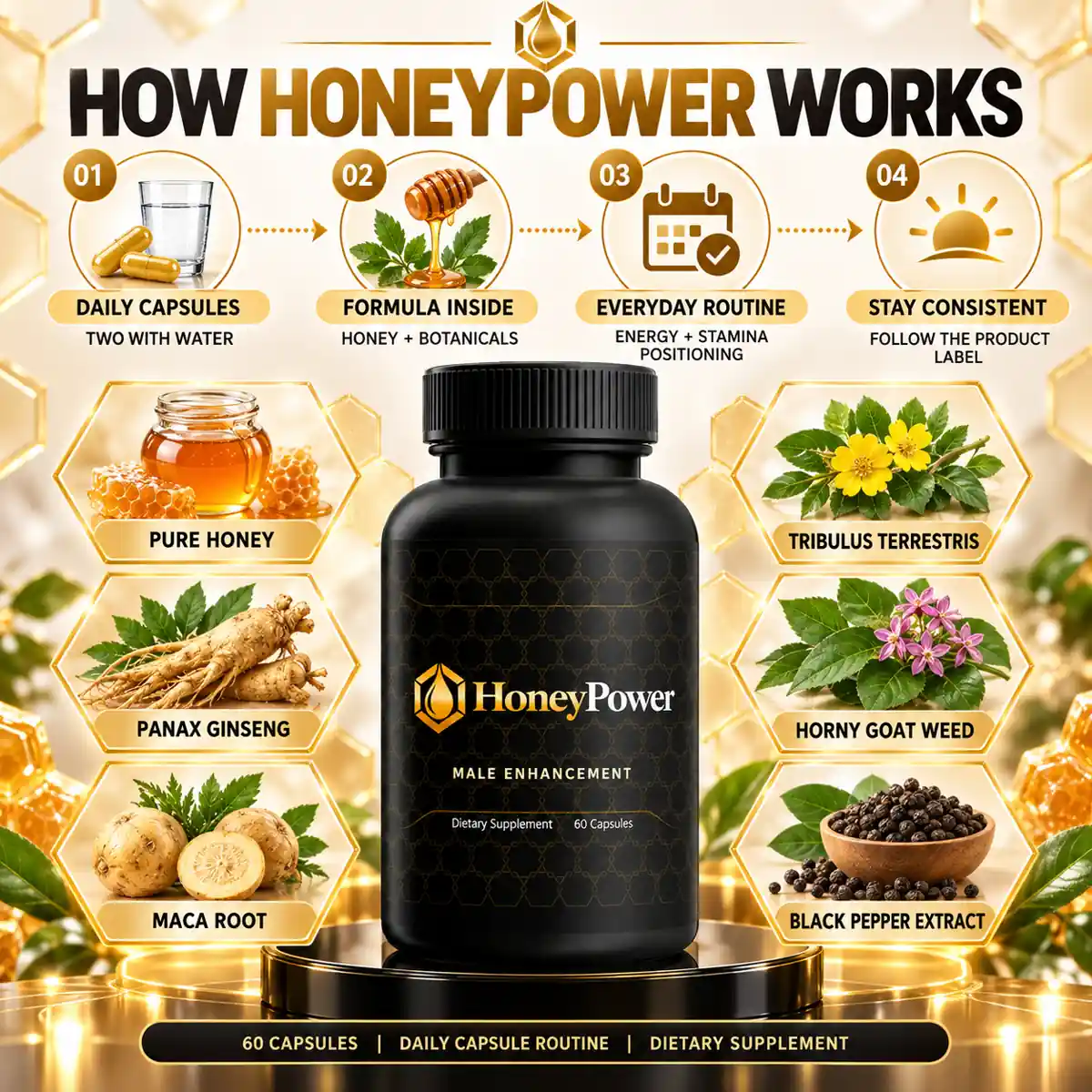
Six named botanicals, two capsules a day, and 180 days from purchase, which is six times the length of the longest trial in this literature.
One bottle $69 · six bottles $294 · 180-day money-back guarantee
Order HoneyPower On The Official WebsiteTwo capsules a day · 60 per bottle · lot HON-26/MY-5579
Not all ginseng is the same material
A printed weight is only half of what a reader needs, and this ingredient demonstrates why better than most.
Root against berry
The berry extract trial used a completely different part of the plant from the root extracts in the other studies. Different plant parts carry different ginsenoside profiles, and a trial of one does not transfer to the other. A label that says only “ginseng” has not told you which.
Red against white
Korean red ginseng is steamed and dried, which changes its chemistry. Most of the erectile trials used red specifically. A white ginseng product at the same milligram figure is not the same thing on the evidence, and that distinction is rarely printed.
Standardisation
Trials describe their material by what it is standardised to, usually a ginsenoside percentage. Two extracts at the same printed weight can differ several-fold in active content. Without a marker on the label, a milligram figure is less informative than it looks, and without any figure at all the question cannot even be asked.
The other literature: fatigue
Erectile function is not the only endpoint ginseng has been trialled against, and the fatigue work is arguably more relevant to what a daily capsule is sold for.
A systematic review of ginseng for fatigue collects trials across several populations. The studies in it are heterogeneous and their doses vary, but the direction is more consistent than in the erectile literature.
For a reader deciding what to watch for during a trial of his own, this is the more tractable endpoint. Afternoon energy is easier to score honestly than anything else on a men’s vitality label, and it is the outcome with the most human work behind it on this particular panel.
The interaction worth raising first
One thing about ginseng belongs in any article about it, and it is not a side effect.
A randomised controlled trial gave American ginseng at one gram twice daily and measured warfarin’s effect falling. Warfarin is dosed to a blood test, so anything that moves the number moves a patient off his target.
That is a specific, measured, published finding rather than a general caution. Anyone on an anticoagulant should name ginseng when he raises a supplement with whoever manages his INR, and he should do it before the first capsule rather than after the first bottle.
On a label with a printed amount, a man on warfarin can see how far his serving is from the two grams a day the trial used. On a label without one, he cannot, and the honest answer is to raise it with his prescriber using the ingredient name rather than a figure nobody can supply.
Five questions worth asking of any ginseng row
These sort the labels quickly and none of them takes more than a moment.
- How many milligrams? Without a figure the row cannot be compared with any trial.
- Panax ginseng or another species? American ginseng and Siberian ginseng are different plants with different literatures.
- Root or berry? The two have separate trials and separate results.
- Red or white? Most of the erectile trials used red specifically.
- Standardised to what? A ginsenoside percentage is what makes two products comparable.
- And before any of those: are you on warfarin or another anticoagulant?
On the bottle this website sells, the first five answers are: no figure, Panax ginseng, plant part not stated, red or white not stated, and no marker given. That is a longer list of blanks than most labels produce, and it is set out in full on the ingredients page rather than softened here.
The companion piece is what the tribulus trials actually found, which is the ingredient on this panel where the human evidence points the other way.
References
- Lee and colleagues, 2021 (Cochrane Database Syst Rev): the Cochrane review of ginseng for erectile dysfunction. It pooled nine studies in 587 men followed for twelve weeks at most, and the combined effect fell short of the review’s own threshold for a difference a man would notice. PubMed record 33871063
- Lee and colleagues, 2022 (World J Mens Health): the authors’ own summary of their Cochrane review of ginseng for erectile dysfunction. PubMed record 34169686
- de Andrade and colleagues, 2007 (Asian J Androl): Korean red ginseng for erectile dysfunction at 1,000 mg three times a day, 3 g in all, for 12 weeks. PubMed record 16855773
- Choi and colleagues, 2013 (Int J Impot Res): a multicenter, double-blind, placebo-controlled study of Korean ginseng berry extract in men with erectile dysfunction, four 350 mg tablets a day (1,400 mg) for 8 weeks. PubMed record 23254461
- Choi, Seong and Rha, 1995 (Int J Impot Res): Korean red ginseng for erectile dysfunction in ninety men split into three groups; the paper reports partial responses only and no complete remission. PubMed record 8750052
- Jang and colleagues, 2008 (Br J Clin Pharmacol): a systematic review of the red ginseng trials for erectile dysfunction. PubMed record 18754850
- Arring and colleagues, 2018 (J Altern Complement Med): a systematic review asking whether ginseng helps fatigue. PubMed record 29624410
- Yuan and colleagues, 2004 (Ann Intern Med): a randomized, controlled trial in healthy volunteers in which American ginseng at 1 g twice a day weakened the effect of warfarin. PubMed record 15238367