HoneyPower Official Website › How It Works
How It WorksHow HoneyPower Works, Route by Route
HoneyPower works by building up with daily use, not by acting on the day, taken as two capsules every morning.
Its six ingredients cover three jobs: energy and fatigue, desire, and absorption. Ginseng has the strongest human research of the six.
See what each botanical is on the HoneyPower ingredients page.
What the six are meant to do, and how far the published work carries each one.
Written by the HoneyPower Team at MyhoneypowerMedical review: Dr. Shawn Blick, MDRevised
What happens after a HoneyPower capsule is swallowed
A capsule, a stomach, and six ingredients going six different ways.
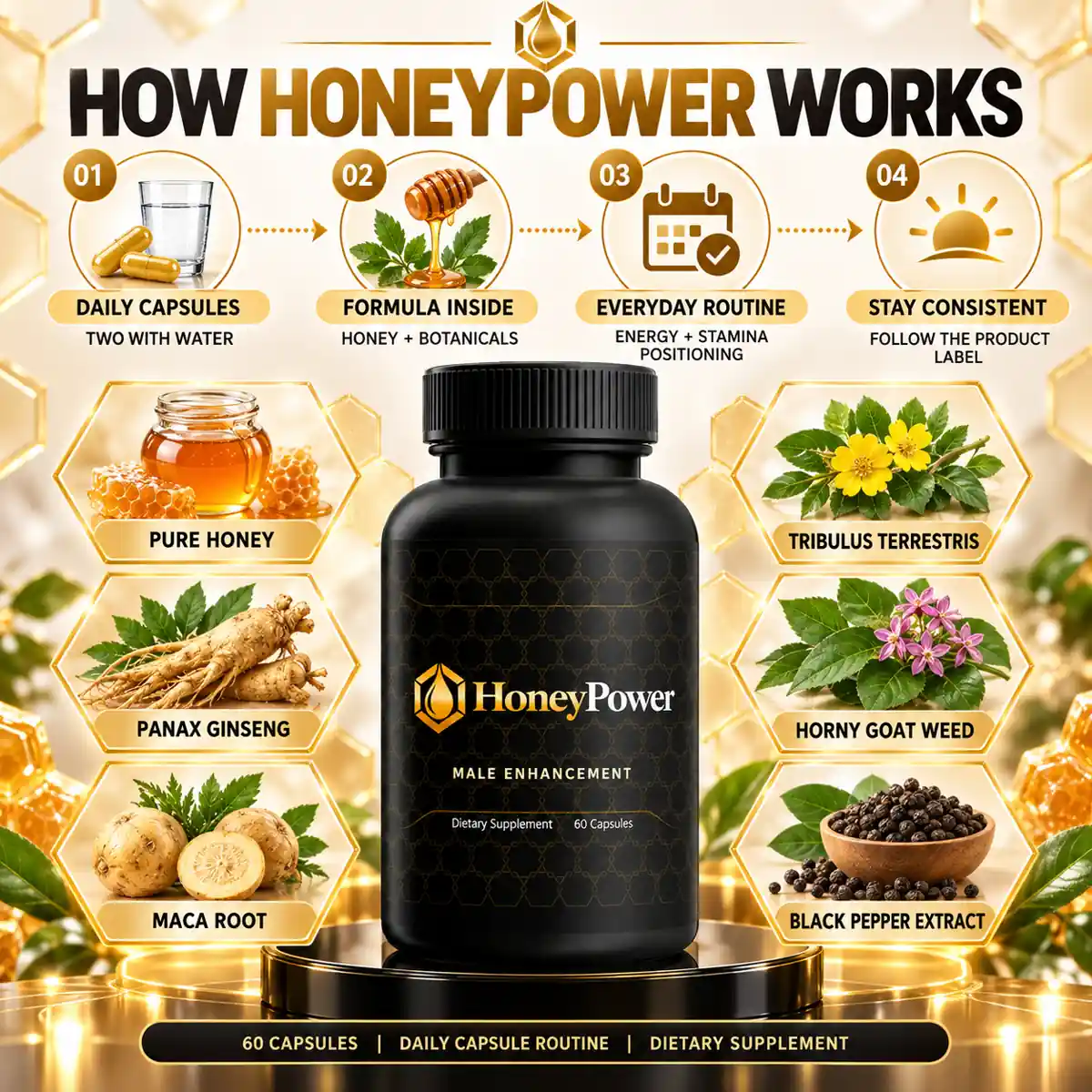
The shell opens in the stomach inside a few minutes and the powder disperses into whatever is already there. From that point each of the six follows its own route. Honey is a sugar and is handled as one. The four plant powders release their compounds gradually across the small intestine. The piperine begins acting on the gut wall almost immediately.
Nothing in that sequence produces a sensation, and it is worth saying so plainly because the category trains people to expect one. There is no stimulant on this panel, nothing that widens a blood vessel on contact, and nothing with an acute effect a man would notice on the afternoon of day one.
The seller’s own material talks in weeks rather than hours, and the buyers quoted on the reviews page say the same thing in less polished language. A formula built from four slow botanicals behaves like four slow botanicals.
The three routes the HoneyPower ingredients are said to take
Three jobs, and which of the six is meant to do each one.
Route one: the energy and fatigue story
This is where ginseng carries the weight, and it has the most human work behind it of anything on the panel. Trials have run it in chronic fatigue, fatigue in rheumatic disease, cancer-related fatigue and a second oncology trial, with a review pulling them together. Doses run around 1 to 2 grams a day. Honey contributes carbohydrate, which is energy in the ordinary dietary sense rather than in a pharmacological one.
Route two: the erectile and desire story
Three ingredients sit here and they arrive by different paths. Ginseng has the Cochrane review of nine trials. Maca has two randomised desire trials and one in antidepressant-associated difficulty. Tribulus has a phase IV erectile trial at 1,500 mg. Icariin has PDE5 inhibition in a test tube and no erectile trial in people at all. The meta-analysis of herbal treatments covers the area and is cautious about all of it.
Route three: absorption
Black pepper extract is the only ingredient on the panel whose job is to act on the others. Piperine inhibits CYP3A4 and P-glycoprotein, which between them decide how much of a swallowed compound reaches the bloodstream rather than being cleared or pumped back out. The bioavailability literature treats that as the whole reason for its presence in a blend.
Those three routes are the seller’s implied mechanism read back from the ingredient list, and they are a fair reading of it. A man who wants to know whether the formula makes sense on paper has his answer: it does. Each route has a plausible occupant and at least one has real human trials.
The gap between a mechanism that makes sense and a result a buyer can feel is where the next section sits, and it is the only place on this page where that gap is discussed.
Where the HoneyPower mechanism story runs ahead of the evidence
The difference between a plausible route and a measured result.
A mechanism is a description of how something could work. A trial is a measurement of whether it did. Three of the routes above are supported by mechanism and only parts of them are supported by measurement, and the difference is worth holding onto.
| The step | What supports it | What does not exist |
|---|---|---|
| Icariin reaches the same enzyme the prescription drugs act on | Enzyme inhibition in a test tube and cGMP in cultured cells | Any human trial with an erectile endpoint |
| Ginseng improves erectile scores | Nine randomised trials pooled by Cochrane, 587 men | Follow-up beyond 12 weeks, and trials outside small samples |
| Maca raises desire | Two randomised trials, one with a clean dose comparison | An effect at the lower of the two doses tested |
| Tribulus raises testosterone | Marketing, and a long folk reputation | A measured androgen change. Neychev dosed young men directly and found none |
| Piperine lifts the other five | A documented effect on CYP3A4 and P-glycoprotein | Any measurement of piperine with honey, ginseng, maca, tribulus or icariin |
| Six ingredients at once beat one ingredient alone | Nothing published | A trial of this combination, or of anything close to it |
The right-hand column is what has not been run, read from the searches behind the sources at the foot of this page.
The bottom row is the one that applies to every multi-botanical formula sold in this category and it is rarely stated. Nobody has tested these six together. The evidence that exists is evidence about single ingredients at single doses, and a blend inherits none of it automatically.
This desk sells the product and still says that, because a buyer who understands it will judge the bottle on the right question. The right question is whether a modest daily dose of six plants, taken for three months, is worth $177 to him with six months to ask for the money back.
Why HoneyPower produces nothing you can feel on day one
Why a formula of four slow plants behaves like four slow plants.
Buyers who expect a sensation from a botanical capsule are usually comparing it with something that has one. Caffeine, nitric oxide precursors and prescription erectile drugs all announce themselves, and none of those three is on this panel.
Four of the six ingredients here work, where they work at all, by accumulating. The ginseng trials ran eight to twelve weeks. The maca trials ran twelve. The tribulus erectile trial ran three months. Those are not cautious study designs chosen to flatter a slow product; they are how long the effects took to become measurable.
The practical consequence is a planning one. A single bottle is thirty days, which is shorter than any trial behind the four plant ingredients, so a man testing this formula on one bottle is testing it for less time than the research did.
- Nothing on day one is the expected result, not a sign of a bad batch.
- The buyers on the reviews page report 3–6 weeks as the commonest wait.
- Three bottles covers ninety days, which matches the shortest useful trial length.
- The 180-day guarantee runs from purchase, so a slow start does not eat the window.
What black pepper extract is doing in the HoneyPower formula
An absorption agent, what it does, and what has never been measured about it.
The sixth row confuses people more than the other five, because black pepper is a kitchen spice and the other names are supplement-aisle names. Its presence is deliberate and the reasoning behind it is well documented.
Botanical compounds are often poorly absorbed. A share of what is swallowed never crosses the gut wall, and a further share is cleared by the liver before it reaches circulation. Piperine interferes with both steps. The demonstration everybody quotes gave 20 mg of piperine with 2 g of curcumin and measured a twenty-fold rise in curcumin’s blood levels.
Two things follow, and only one of them is in the marketing. The first is that a small dose of a botanical can behave like a larger one when piperine is present. The second is that the same property applies to medicines, which is why it appears on the interaction list on the side effects page rather than only here.
Piperine’s famous result was measured on curcumin, which is not on this panel. No published work sets it beside honey, ginseng, maca, tribulus or icariin, so how much it changes the absorption of these five is unknown. It is a reasonable inclusion with an unmeasured effect in this particular company.
How HoneyPower differs from a prescription treatment
What a supplement is allowed to be, set beside what a medicine is.
| A prescription erectile drug | HoneyPower | |
|---|---|---|
| What it is | A medicine, approved for a named condition | A dietary supplement, sold without approval for any condition |
| Regulatory status | Reviewed for efficacy and safety before sale | Not reviewed, and not FDA-approved |
| Timing | Taken before an occasion, acts within an hour | Taken every day, discussed in weeks |
| What it is allowed to claim | Treatment of a diagnosed condition | Support for a structure or function, which is what the nine label lines do |
| Dose transparency | An exact milligram figure on every tablet | Six names on a graphic and no figure beside any of them |
| Cost shape | Per occasion, or a monthly prescription | $49 to $69 a bottle, one bottle a month |
The left-hand column describes a drug class rather than a specific product, and nothing here suggests the two are interchangeable.
That table exists because the icariin story invites the comparison and the comparison does not hold. PDE5 inhibition in glassware is a shared word, not a shared category. The American Urological Association guideline and the MedlinePlus consumer page both set out what actually has evidence for erectile difficulty, and a botanical blend is not in either document.
The FDA’s list of tainted sexual enhancement products is worth knowing about for a different reason. Some products in this category have been found to contain undeclared prescription drug analogues, which is exactly the situation a buyer wants to avoid. A product that names six recognisable botanicals and makes no promise of an acute effect is the opposite of that pattern.
How HoneyPower works: common questions
How long does HoneyPower take to work?
Does HoneyPower work immediately?
Does HoneyPower raise testosterone?
Is HoneyPower like Viagra?
Can I take HoneyPower alongside an erectile prescription?
What does HoneyPower actually do in the body?
Sources behind the HoneyPower mechanism
The trials, reviews and guidelines named on this page.
- Lee and colleagues, 2021 (Cochrane Database Syst Rev): the Cochrane review of ginseng for erectile dysfunction. It pooled nine studies in 587 men followed for twelve weeks at most, and the combined effect fell short of the review’s own threshold for a difference a man would notice. PubMed record 33871063
- Lee and colleagues, 2022 (World J Mens Health): the authors’ own summary of their Cochrane review of ginseng for erectile dysfunction. PubMed record 34169686
- Sung and colleagues, 2020 (Complement Ther Med): a randomized, double-blind, placebo-controlled trial of Korean red ginseng in middle-aged adults with moderate chronic fatigue. PubMed record 31987248
- Cho and colleagues, 2024 (Korean J Intern Med): a randomized, double-blind, placebo-controlled trial of Korean red ginseng for fatigue in people with rheumatic diseases. PubMed record 38576235
- Yennurajalingam and colleagues, 2017 (J Natl Compr Canc Netw): a randomized, placebo-controlled trial of Panax ginseng for fatigue in people with advanced cancer. PubMed record 28874596
- Barton and colleagues, 2013 (J Natl Cancer Inst): the N07C2 randomized, double-blind trial of Wisconsin ginseng, Panax quinquefolius, for cancer-related fatigue. PubMed record 23853057
- Arring and colleagues, 2018 (J Altern Complement Med): a systematic review asking whether ginseng helps fatigue. PubMed record 29624410
- Borrelli and colleagues, 2018 (Drugs): a systematic review and meta-analysis of the herbal supplements studied for erectile dysfunction. PubMed record 29633089
- Gonzales and colleagues, 2002 (Andrologia): healthy adult men took maca at 1,500 mg or 3,000 mg a day. Their reported sexual desire rose while serum testosterone stayed where it was. PubMed record 12472620
- Dording and colleagues, 2008 (CNS Neurosci Ther): a pilot dose-finding trial of maca for sexual side effects of SSRI antidepressants, 1.5 g against 3.0 g a day; only the 3 g group improved. PubMed record 18801111
- Zenico and colleagues, 2009 (Andrologia): a randomised, double-blind trial in men with mild erectile dysfunction, using 2,400 mg of dry maca extract a day and rating well-being and sexual performance. PubMed record 19260845
- Kamenov and colleagues, 2017 (Maturitas): a prospective, randomized, double-blind, placebo-controlled trial of tribulus in men with sexual dysfunction, two 250 mg film-coated tablets three times a day (1,500 mg a day), each tablet standardised to at least 112.5 mg of furostanol saponins. PubMed record 28364864
- Neychev and Mitev, 2005 (J Ethnopharmacol): healthy young men took tribulus at 10 and 20 mg per kg of body weight a day in three doses, roughly 700 to 1,400 mg for a 70 kg man, and their androgen production was measured. It did not change. PubMed record 15994038
- Dell’Agli and colleagues, 2008 (J Nat Prod): laboratory work in which icariin derivatives blocked the human PDE5 enzyme in vitro, with no people involved. PubMed record 18778098
- Ning and colleagues, 2006 (Urology): icariin tested on PDE5 activity and cyclic GMP in cultured cavernous smooth muscle cells, not in people. PubMed record 17169663
- Xiao, Wignall and Brown, 2016 (Am J Drug Alcohol Abuse): an open-label pilot study giving icariin at up to 300 mg a day for eight weeks to people with bipolar disorder and alcohol use disorder. It had no erection endpoint. PubMed record 26809351
- Cui and colleagues, 2015 (J Sex Med): a urologist’s walk-through of the ingredients found in best-selling men’s sexual health products. PubMed record 26531010
- Shoba and colleagues, 1998 (Planta Med): curcumin absorption with and without piperine in animals and human volunteers; in people, 20 mg of piperine taken with 2 g of curcumin raised curcumin’s blood level. The effect was measured on curcumin, not on honey, ginseng, maca, tribulus or icariin. PubMed record 9619120
- Bhardwaj and colleagues, 2002 (J Pharmacol Exp Ther): piperine from black pepper blocked the human drug transporter P-glycoprotein and the CYP3A4 enzyme. The mechanism that raises a nutrient’s blood level can raise a medicine’s as well. PubMed record 12130727
- Zhou, Lim and Chowbay, 2004 (Drug Metab Rev): a review of how herbal products act on P-glycoprotein. PubMed record 15072439
- Anand and colleagues, 2007 (Mol Pharm): a review of why curcumin is poorly absorbed and of the ways tried to improve it. PubMed record 17999464
- Burnett and colleagues, 2018 (J Urol): the American Urological Association’s guideline on erectile dysfunction. PubMed record 29746858
- MedlinePlus, U.S. National Library of Medicine: the consumer health topic page on erectile dysfunction, what causes it and how it is treated. medlineplus.gov topic page
- U.S. Food and Drug Administration: the agency’s running notices on sexual enhancement and energy products found to contain undeclared drug ingredients. fda.gov notices
- Petre and colleagues, 2023 (Nutrients): products sold for erectile dysfunction, analysed alongside a systematic review and meta-analysis of their ingredients and advice on sensible use. PubMed record 37686709
- Balasubramanian and colleagues, 2019 (J Sex Med): a look at popular online testosterone-booster products. Across nineteen ingredients and the 191 studies behind the ten most common, 19% of the research involved people at all, and 46% of the 37 human studies found no change in testosterone. PubMed record 30770069
Give HoneyPower the run the research took
The trials behind these plants ran eight to twelve weeks. Three bottles covers ninety days, and the 180-day window covers six months.
One bottle $69 · six bottles $294 · 180-day money-back guarantee
Order HoneyPower On The Official WebsiteTwo capsules a day · 60 per bottle · lot HON-26/MY-5579