HoneyPower Official Website › Ingredients
IngredientsHoneyPower Ingredients
Six botanicals are named on the HoneyPower ingredient graphic and no amount is printed for any of them.
They are pure honey, Panax ginseng, maca root, tribulus terrestris, horny goat weed and black pepper extract, in that order. Two capsules a day carry the whole blend. This page gives each one its research dose, read from the trial that ran it.
Six names, six research doses, and one honest gap between them.
The six botanicals named on the HoneyPower artwork
One graphic, six names, and a photograph beside each of them.
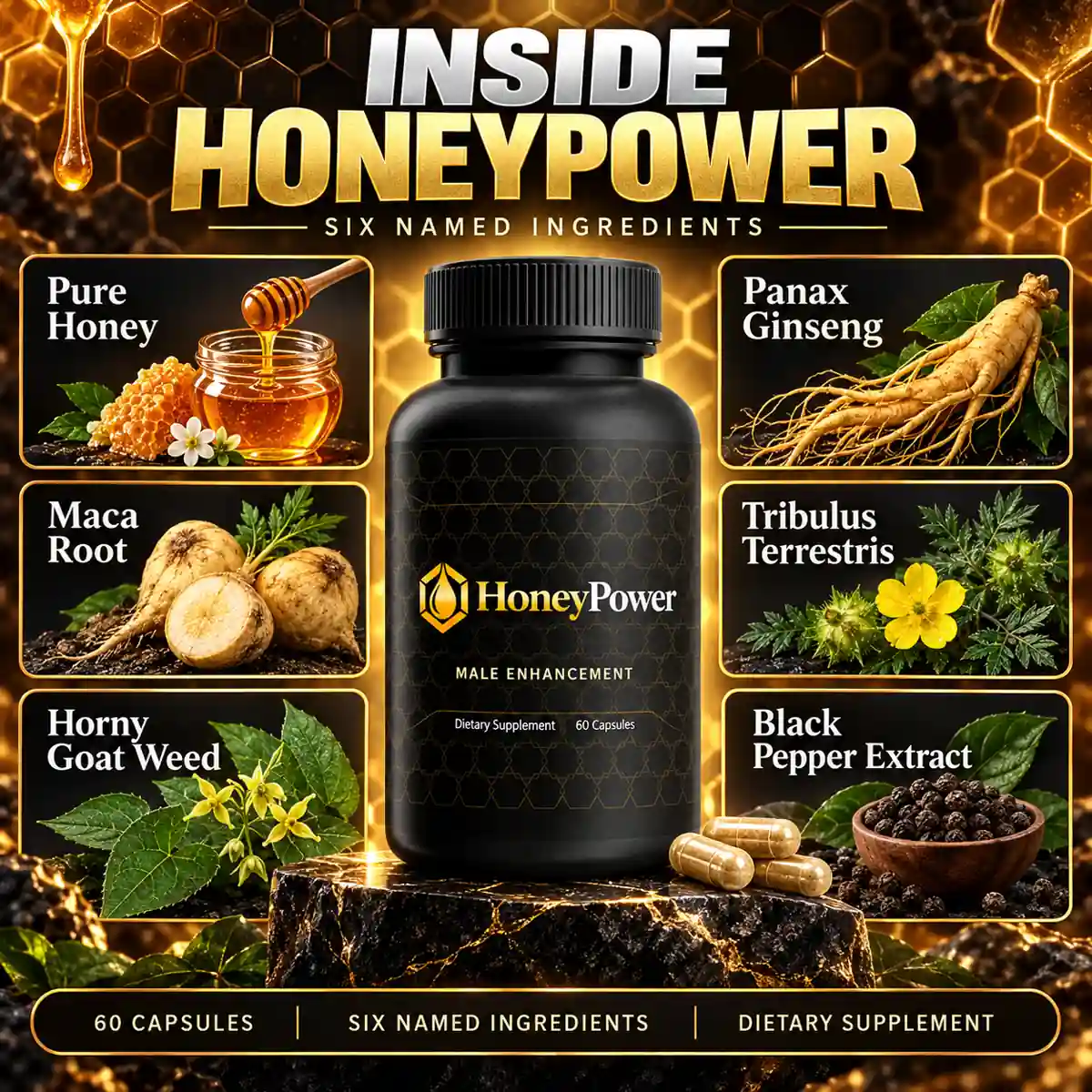
The seller publishes one graphic whose entire job is to say what is in the bottle. It carries six names and a photograph beside each: honey, Panax ginseng, maca root, tribulus terrestris, horny goat weed and black pepper extract. That graphic is the source for every name on this page, and the order below is its order.
Two of the six are foods eaten by the spoonful at home. Three are botanicals with their own clinical literature in men’s health. The sixth is an absorption agent added to act on the other five rather than to do anything by itself. A reader who understands that split already understands most of the formula.
Each card below gives the plant, the part used where the seller states it, and the amount the published human research put behind that ingredient. The amounts belong to the studies, not to this capsule.
What each HoneyPower ingredient is, and what has been measured with it
Six cards, in the order the seller’s own graphic lists them.
Pure Honey
Mel, the whole foodNamed first on the seller’s graphicHoney leads the ingredient graphic and gives the product its name, which sets an expectation the capsule format has to work against. A jar of honey is eaten by the spoonful. The human trials behind it were run the same way: 50 grams of carbohydrate from honey a day for two weeks, 70 grams before every training session across eight weeks, and 1.2 grams per kilogram of body weight daily in a crossover trial.
What those trials measured is worth knowing before anyone assumes the bottle inherits them. Two looked at oxidative markers in trained cyclists, one at blood lipids, one at glucose response. A 2025 crossover trial of a honey powder product found no endurance benefit at all. None of them studied erections, drive or stamina in the sense this bottle is sold for.
Powdered honey is a real ingredient and it goes into capsules routinely. The question a buyer can hold onto is one of scale rather than of quality: a capsule holds a fraction of a gram of anything, and the honey research starts at fifty grams.
Panax Ginseng
Panax ginseng, rootNamed secondOf the six, this is the one with a real body of human work aimed at the thing the bottle is sold for. The 2021 Cochrane review pooled nine studies in 587 men with erectile difficulty and found ginseng ahead of placebo, with the authors flagging small samples and short follow-up. Their own plain summary of the review is more cautious than the abstract reads.
The doses are the part worth carrying away. A twelve-week Brazilian trial gave 1,000 mg three times a day, so three grams. A Korean trial gave four 350 mg tablets daily for eight weeks. A berry-extract trial used 1,400 mg a day. The fatigue literature runs similarly: 2,000 mg a day for eight weeks in cancer-related fatigue is a representative figure.
Ginseng also carries the clearest interaction on this panel, and it is named once here and once on the side effects page rather than repeated through the site. A randomised trial gave 1 g of ginseng twice daily to men on warfarin and measured a fall in the drug’s effect.
Maca Root
Lepidium meyenii, hypocotylNamed thirdMaca is a Peruvian root vegetable, dried and milled, and it is eaten as food at home in quantities no capsule approaches. The botanical and phytochemical literature treats it as a cruciferous crop rather than as a concentrated extract, which is why the trial doses are measured in grams.
The dose-finding work is unusually clean for a botanical. Gonzales ran 1,500 mg against 3,000 mg for twelve weeks and both arms moved on a desire questionnaire. Dording’s later trial ran 1.5 g against 3.0 g and only the 3 g arm separated from placebo. A twelve-week safety trial used 3 g a day and reported no change in hormone measurements. The systematic review of the area calls the evidence limited and the trials small.
That pattern is useful rather than damning. It says the ingredient has a threshold, the threshold was measured, and it sits at three grams a day of dried root.
Tribulus Terrestris
Tribulus terrestris, fruit or aerial partsNamed fourthTribulus is the ingredient most associated with the testosterone claim, and it is the one where the human work is most direct about that claim. Neychev gave 10 and 20 mg per kilogram a day to young men and measured androgen production directly. Nothing moved. A later review of the plant’s wider pharmacology makes the same point about the hormonal story.
Where it has shown something, the doses are large and standardised. The phase IV trial used 1,500 mg a day of an extract standardised to furostanol saponins in men with erectile difficulty. A three-month trial used 750 mg a day. The rugby trial used 450 mg for five weeks and found no body-composition or strength difference. The 2026 meta-analysis and a 2025 review both land on the same summary: some erectile signal, no androgen signal.
Standardisation matters more here than with most plants, because the saponin content of tribulus varies with where it grew and which part was harvested.
Horny Goat Weed
Epimedium species, aerial partsNamed fifthThe name does most of the selling and the laboratory work does the rest. Icariin, the compound epimedium is standardised for, inhibits PDE5 in a test tube and raises cGMP in cultured cavernous smooth muscle cells. PDE5 is the enzyme the prescription erectile drugs act on, which is why the comparison gets made so often.
What has not happened is the trial. The only human trial of isolated icariin found in this search gave 300 mg a day for eight weeks, open label, to people with bipolar disorder and an alcohol use disorder, and its endpoint was mood. A urologist’s review of the herbal erectile market says the same thing in fewer words: the glassware is interesting and the clinic is empty.
Two practical notes travel with it. NIH LiverTox records the usual commercial product as one 250 mg or 500 mg capsule a day, which is the nearest thing to a reference dose anywhere in the literature, and it documents the liver injury reports that go with the plant.
Black Pepper Extract
Piper nigrum, fruitNamed sixthThe sixth row is not a botanical the product is sold on. It is there to change what happens to the other five. Piperine, the active fraction of black pepper, slows two of the body’s clearance systems, and the famous demonstration is Shoba’s 1998 study: 20 mg of piperine alongside 2 g of curcumin lifted curcumin’s blood levels by a factor the paper puts at twenty.
The mechanism is documented on both fronts. Piperine inhibits CYP3A4, the liver enzyme that clears a large share of prescription medicines, and inhibits P-glycoprotein, the pump that throws compounds back out of the gut wall. The bioavailability literature treats both as the point of adding it.
The honest limit on the row is specific rather than general: nobody has measured piperine against honey, ginseng, maca, tribulus or icariin. The effect it is famous for was measured on one compound, curcumin, in one study design.
Which HoneyPower ingredient has the strongest human evidence?
Six ingredients, ranked by how close their research sits to this use case.
| Ingredient | Human work aimed at this use | How solid it is |
|---|---|---|
| Panax ginseng | Nine randomised studies, 587 men, pooled in a Cochrane review | The strongest on the panel. Small samples, follow-up capped at 12 weeks |
| Maca root | Two randomised desire trials and a dose-finding trial | Real, narrow, and the effect appeared only at the higher arm |
| Tribulus terrestris | A phase IV erectile trial, a three-month trial, several sports trials | Mixed. Erectile scores moved, measured androgens did not |
| Pure honey | Metabolic and athletic trials at 50 to 84 grams a day | Good trials, different questions. None with this bottle’s endpoints |
| Horny goat weed | Cell and enzyme work on icariin; one open-label human trial on mood | The weakest link between a mechanism and a person |
| Black pepper extract | One well-known pharmacokinetic study, on curcumin | Solid for what it measured. Never measured against these five |
Ranked by how close the published work sits to the use this bottle is sold for, not by how much of each ingredient the capsule contains.
Read down that table and a shape appears. The ingredient with the best evidence is second on the graphic rather than first, the ingredient with the most famous name has the least human work behind it, and the food at the top of the list is the one nobody has studied for this purpose at all.
That is not unusual for a six-botanical blend and it is not a reason to dismiss the bottle. It is a reason to read the ginseng and maca rows more carefully than the others, because those two are where a buyer’s expectation has something to attach itself to.
What two HoneyPower capsules would have to hold
One section, the whole arithmetic, and nothing about it repeated elsewhere.
The seller gives no amount for any of the six, so the comparison this desk normally makes cannot be completed on the label side. The other side is public, and it is worth laying out because the arithmetic is the most useful thing on this page.
| Ingredient | Lowest amount that has shown something in people | Source of that figure |
|---|---|---|
| Pure honey | 50 g a day of carbohydrate from honey, for 14 days | Raatz, metabolic endpoints |
| Panax ginseng | 1,400 mg a day for 8 weeks | Choi, berry extract, erectile scores |
| Maca root | 3 g a day for 12 weeks in the arm that separated | Dording, dose comparison |
| Tribulus terrestris | 450 mg a day, and 1,500 mg in the erectile trial | Rogerson; Kamenov |
| Horny goat weed | 300 mg a day of isolated icariin, open label | Xiao, mood endpoint |
| Black pepper extract | 20 mg of piperine, with curcumin | Shoba, absorption endpoint |
Every figure is the amount a published trial gave, read from the paper. None of them is an estimate of what this capsule contains.
Add the five plant rows at their lowest published figures and the total clears five grams a day before the honey is counted. A two-capsule serving of a capsule this size carries a fraction of that. There is no way to know which fraction, because the artwork gives the reader nothing to check.
What follows from it is a question rather than a verdict. If the six are present at a share of those amounts, the formula is a small daily dose of six plants with a long guarantee attached, and it should be judged as that. If a buyer wanted the ginseng figure from the Cochrane trials, a single-ingredient capsule that prints its milligrams would get him there and this one cannot promise to.
Back-calculating from a capsule size, borrowing a competitor’s panel or writing “typically contains” would all produce a number, and a number on a page reads as a fact about the product. The six names are published. The six amounts are not, so they appear nowhere on this website.
What plant part and what extract does HoneyPower use?
Which questions the graphic answers, and which it leaves for the buyer.
Botanical rows carry two pieces of information beyond the name, and the difference between them decides whether a trial dose is comparable at all. The first is the plant part. The second is the extract ratio or the marker standardisation.
| Row on the graphic | Plant part stated | Standardisation stated |
|---|---|---|
| Pure Honey | Not applicable; honey is the whole food | None |
| Panax Ginseng | Not stated. Trials use root | None. Trials standardise to ginsenosides |
| Maca Root | Root, stated in the name | None. Trials use dried, milled hypocotyl |
| Tribulus Terrestris | Not stated. Trials use fruit or aerial parts | None. The erectile trial used furostanol saponins |
| Horny Goat Weed | Not stated. Trials use aerial parts | None. Trial work uses isolated icariin |
| Black Pepper Extract | Fruit, implied by the name | None. The reference product is 95% piperine |
The right-hand columns describe what the published research used, so that a reader can see which questions the artwork leaves open.
Two of those rows matter more than the rest. Tribulus without a saponin figure is a plant whose active content swings with the growing region, which is why reviews of the plant keep returning to standardisation. Epimedium without an icariin percentage is the same problem with a smaller literature behind it.
The maca row is the cleanest of the six. Maca in trials is the dried root milled to a powder, which is also what a capsule would carry, so the only open question there is quantity rather than identity.
What is in a HoneyPower capsule besides the six botanicals?
What the badge row states, and the one question it leaves open.
Every capsule has a shell and most have a flow agent, and this artwork carries no other-ingredients line to read them off. What the badge row does state is three things about how the product is made, and those three are quoted below in the wording the pack uses.
- “Manufactured in a GMP certified facility”, which is a statement about the plant rather than about what went into the capsule.
- “No artificial colors, flavors or preservatives”, which rules a category of additive out without naming what is in.
- “Proudly made in the USA with globally sourced ingredients”, which says the blending and encapsulation happened domestically and the plants did not.
The shell itself is the one thing a vegetarian buyer usually wants confirmed, and the artwork does not say whether it is gelatin or a plant cellulose. The order desk on +1 (302) 200-3480 can read the current batch specification, and this page will carry the answer once it is confirmed in writing rather than over the phone.
Anyone with a severe allergy has a shorter route to certainty. Ask for the batch specification sheet for lot HON-26/MY-5579 before ordering rather than after, because the refund window is generous but a reaction is not something a refund fixes.
Which HoneyPower ingredients have a documented drug interaction?
Two ingredients, two medicines, stated with the trial behind each.
Two of the six have a documented interaction that is worth naming precisely once, with the medicine it involves, rather than being folded into a general caution on every section of this website.
Ginseng and warfarin
A randomised trial gave 1 g of ginseng twice daily to patients on stable warfarin and measured a fall in the anticoagulant’s effect, reported in the primary trial and echoed in a mechanical heart valve case. The LiverTox chapter and the NCCIH summary both carry it. Anyone taking an anticoagulant should raise this specific interaction with the prescriber who manages the dose.
Piperine and anything cleared by CYP3A4
Black pepper extract is on this panel to lift absorption, and the enzyme it acts on handles a large share of prescription medicines. The CYP3A4 work and the P-glycoprotein work describe the mechanism. The practical version is short: the same property that raises a nutrient’s blood level can raise a medicine’s.
Neither of those is a reason to avoid the product outright and neither is stated here as a hazard peculiar to this brand. They are properties of two ingredients that hundreds of formulas carry, and they are set out once so that a reader who takes either class of medicine knows what to ask about. The side effects page carries the fuller list, including what LiverTox records for tribulus and for maca.
HoneyPower ingredient questions
How many ingredients are in HoneyPower?
Does HoneyPower have a Supplement Facts panel?
Is there caffeine or any stimulant in HoneyPower?
Is HoneyPower suitable for vegetarians?
Which HoneyPower ingredient is doing the most work?
Does HoneyPower contain any of the ingredients found in tainted products?
Sources behind the HoneyPower ingredient list
Every study named above, grouped by the ingredient it belongs to.
- Tartibian B, Maleki BH. The effects of honey supplementation on seminal plasma cytokines, oxidative stress biomarkers, and antioxidants during 8 weeks of intensive cycling training. J Androl. 2012;33(3):449-61. PMID 21636735. Dose: 70 g of natural honey 90 minutes before each training session. https://pubmed.ncbi.nlm.nih.gov/21636735/
- Al-Tamimi AM, Petrisko M, Hong MY, et al. Honey does not adversely impact blood lipids of adult men and women: a randomized cross-over trial. Nutr Res. 2020;74:87-95. PMID 31958656. Dose: honey or sucrose supplying 1.2 g of carbohydrate per kg per day. https://pubmed.ncbi.nlm.nih.gov/31958656/
- Raatz SK, Johnson LK, Picklo MJ. Consumption of Honey, Sucrose, and High-Fructose Corn Syrup Produces Similar Metabolic Effects in Glucose-Tolerant and -Intolerant Individuals. J Nutr. 2015;145(10):2265-72. PMID 26338891. Dose: 50 g of carbohydrate from honey daily for 14 days. https://pubmed.ncbi.nlm.nih.gov/26338891/
- Toniazzo T, Ferreira GA, Dos Santos ML, et al. A Novel Honey Powder-Based Supplement Containing Carbohydrate and Protein Did Not Improve Endurance Performance in Recreationally Trained Cyclists. Int J Sport Nutr Exerc Metab. 2025;35(6):520-529. PMID 40812383. https://pubmed.ncbi.nlm.nih.gov/40812383/
- Lee HW, Lee MS, Kim TH, et al. Ginseng for erectile dysfunction. Cochrane Database Syst Rev. 2021;4(4):CD012654. PMID 33871063. Nine studies, 587 men, follow-up no longer than 12 weeks; the pooled effect was below the review's own threshold for a difference a man would notice. https://pubmed.ncbi.nlm.nih.gov/33871063/
- Lee HW, Lee MS, Kim TH. Ginseng for Erectile Dysfunction: A Cochrane Systematic Review. World J Mens Health. 2022;40(2):264-269. PMID 34169686. https://pubmed.ncbi.nlm.nih.gov/34169686/
- de Andrade E, de Mesquita AA, Claro Jde A, et al. Study of the efficacy of Korean Red Ginseng in the treatment of erectile dysfunction. Asian J Androl. 2007;9(2):241-4. PMID 16855773. Dose: 1,000 mg three times daily -- 3 g a day for 12 weeks. https://pubmed.ncbi.nlm.nih.gov/16855773/
- Choi HK, Seong DH, Rha KH. Clinical efficacy of Korean red ginseng for erectile dysfunction. Int J Impot Res. 1995;7(3):181-6. PMID 8750052. Ninety men in three arms; the paper reports partial responses only and no complete remission. https://pubmed.ncbi.nlm.nih.gov/8750052/
- Choi YD, Park CW, Jang J, et al. Effects of Korean ginseng berry extract on sexual function in men with erectile dysfunction: a multicenter, placebo-controlled, double-blind clinical study. Int J Impot Res. 2013;25(2):45-50. PMID 23254461. Dose: four tablets daily of 350 mg extract -- 1,400 mg a day for 8 weeks. https://pubmed.ncbi.nlm.nih.gov/23254461/
- Yennurajalingam S, Tannir NM, Williams JL, et al. A Double-Blind, Randomized, Placebo-Controlled Trial of Panax Ginseng for Cancer-Related Fatigue in Patients With Advanced Cancer. J Natl Compr Canc Netw. 2017;15(9):1111-1120. PMID 28874596. https://pubmed.ncbi.nlm.nih.gov/28874596/
- Yuan CS, Wei G, Dey L, et al. Brief communication: American ginseng reduces warfarin's effect in healthy patients: a randomized, controlled trial. Ann Intern Med. 2004;141(1):23-7. PMID 15238367. Dose: 1 g twice daily. https://pubmed.ncbi.nlm.nih.gov/15238367/
- Lee YH, Lee BK, Choi YJ, et al. Interaction between warfarin and Korean red ginseng in patients with cardiac valve replacement. Int J Cardiol. 2010;145(2):275-276. PMID 19913311. https://pubmed.ncbi.nlm.nih.gov/19913311/
- Ginseng. In: LiverTox: Clinical and Research Information on Drug-Induced Liver Injury. Bethesda (MD): National Institute of Diabetes and Digestive and Kidney Diseases; updated 14 March 2018. NCBI Bookshelf NBK548200. Likelihood score E -- by itself, an unlikely cause of clinically apparent liver injury. https://www.ncbi.nlm.nih.gov/books/NBK548200/
- Asian Ginseng. National Center for Complementary and Integrative Health, National Institutes of Health. https://www.nccih.nih.gov/health/asian-ginseng
- Gonzales GF, Cordova A, Vega K, et al. Effect of Lepidium meyenii (MACA) on sexual desire and its absent relationship with serum testosterone levels in adult healthy men. Andrologia. 2002;34(6):367-72. PMID 12472620. Dose: 1,500 mg or 3,000 mg daily. Desire rose; serum testosterone did not move. https://pubmed.ncbi.nlm.nih.gov/12472620/
- Shin BC, Lee MS, Yang EJ, et al. Maca (L. meyenii) for improving sexual function: a systematic review. BMC Complement Altern Med. 2010;10:44. PMID 20691074. https://pubmed.ncbi.nlm.nih.gov/20691074/
- Zenico T, Cicero AF, Valmorri L, et al. Subjective effects of Lepidium meyenii (Maca) extract on well-being and sexual performances in patients with mild erectile dysfunction: a randomised, double-blind clinical trial. Andrologia. 2009;41(2):95-9. PMID 19260845. Dose: 2,400 mg of dry extract daily. https://pubmed.ncbi.nlm.nih.gov/19260845/
- Gonzales-Arimborgo C, Yupanqui I, Montero E, et al. Acceptability, Safety, and Efficacy of Oral Administration of Extracts of Black or Red Maca (Lepidium meyenii) in Adult Human Subjects: A Randomized, Double-Blind, Placebo-Controlled Study. Pharmaceuticals (Basel). 2016;9(3):49. PMID 27548190. Dose: 3 g daily for 12 weeks. https://pubmed.ncbi.nlm.nih.gov/27548190/
- Gonzales GF, Villaorduna L, Gasco M, et al. Lepidium meyenii (Maca): a plant from the highlands of Peru -- from tradition to science. Forsch Komplementmed. 2009;16(6):373-80. PMID 20090350. https://pubmed.ncbi.nlm.nih.gov/20090350/
- Maca. In: LiverTox: Clinical and Research Information on Drug-Induced Liver Injury. Bethesda (MD): National Institute of Diabetes and Digestive and Kidney Diseases; updated 10 April 2019. NCBI Bookshelf NBK548552. Likelihood score E -- an unlikely cause of clinically apparent liver injury. https://www.ncbi.nlm.nih.gov/books/NBK548552/
- Neychev VK, Mitev VI. The aphrodisiac herb Tribulus terrestris does not influence the androgen production in young men. J Ethnopharmacol. 2005;101(1-3):319-23. PMID 15994038. Dose: 10 and 20 mg per kg of body weight per day, in three daily intakes -- roughly 700 to 1,400 mg for a 70 kg man. Androgen production did not change. https://pubmed.ncbi.nlm.nih.gov/15994038/
- Kamenov Z, Fileva S, Kalinov K, Jannini EA. Evaluation of the efficacy and safety of Tribulus terrestris in male sexual dysfunction -- A prospective, randomized, double-blind, placebo-controlled clinical trial. Maturitas. 2017;99:20-26. PMID 28364864. Dose: two 250 mg film-coated tablets three times daily -- 1,500 mg a day, standardised to not less than 112.5 mg of furostanol saponins per tablet. https://pubmed.ncbi.nlm.nih.gov/28364864/
- Santos CA Jr, Reis LO, Destro-Saade R, et al. Tribulus terrestris versus placebo in the treatment of erectile dysfunction: A prospective, randomized, double blind study. Actas Urol Esp. 2014;38(4):244-8. PMID 24630840. Dose: 800 mg a day in two doses for 30 days. https://pubmed.ncbi.nlm.nih.gov/24630840/
- Roaiah MF, Elkhayat YI, Rashed LA, GamalEl Din SF, El Guindi AM. Prospective Analysis on the Effect of Botanical Medicine (Tribulus terrestris) on Serum Testosterone Level and Semen Parameters in Males with Unexplained Infertility. J Diet Suppl. 2017;14(1):25-31. PMID 27337519. Dose: 750 mg a day in three divided doses for three months. https://pubmed.ncbi.nlm.nih.gov/27337519/
- Suharyani S, Birowo P, Rasyid N, et al. Tribulus terrestris for management of patients with erectile dysfunction: a systematic review and meta-analysis of randomized trials. Int J Impot Res. 2026;38(1):11-18. PMID 40360723. https://pubmed.ncbi.nlm.nih.gov/40360723/
- Vilar Neto JO, da Silva CA, Bruno da Silva CA, et al. Effects of Tribulus (Tribulus terrestris L.) Supplementation on Erectile Dysfunction and Testosterone Levels in Men -- A Systematic Review of Clinical Trials. Nutrients. 2025;17(7):1198. PMID 40219032. https://pubmed.ncbi.nlm.nih.gov/40219032/
- Rogerson S, Riches CJ, Jennings C, et al. The effect of five weeks of Tribulus terrestris supplementation on muscle strength and body composition during preseason training in elite rugby league players. J Strength Cond Res. 2007;21(2):348-53. PMID 17530942. Dose: 450 mg a day for five weeks. Strength and body composition were no different from placebo. https://pubmed.ncbi.nlm.nih.gov/17530942/
- Santos HO, Howell S, Teixeira FJ. Beyond tribulus (Tribulus terrestris L.): The effects of phytotherapics on testosterone, sperm and prostate parameters. J Ethnopharmacol. 2019;235:392-405. PMID 30790614. https://pubmed.ncbi.nlm.nih.gov/30790614/
- Tribulus. In: LiverTox: Clinical and Research Information on Drug-Induced Liver Injury. Bethesda (MD): National Institute of Diabetes and Digestive and Kidney Diseases; updated 8 August 2022. NCBI Bookshelf NBK583201. Likelihood score E-star -- an unproven but possible rare cause of clinically apparent liver injury at high doses or in people with existing liver disease. https://www.ncbi.nlm.nih.gov/books/NBK583201/
- Dell'Agli M, Galli GV, Dal Cero E, et al. Potent inhibition of human phosphodiesterase-5 by icariin derivatives. J Nat Prod. 2008;71(9):1513-7. PMID 18778098. In vitro. https://pubmed.ncbi.nlm.nih.gov/18778098/
- Ning H, Xin ZC, Lin G, et al. Effects of icariin on phosphodiesterase-5 activity in vitro and cyclic guanosine monophosphate level in cavernous smooth muscle cells. Urology. 2006;68(6):1350-4. PMID 17169663. Cultured cells, not people. https://pubmed.ncbi.nlm.nih.gov/17169663/
- Xiao H, Wignall N, Brown ES. An open-label pilot study of icariin for co-morbid bipolar and alcohol use disorder. Am J Drug Alcohol Abuse. 2016;42(2):162-7. PMID 26809351. Dose: up to 300 mg a day for eight weeks, open-label, in a mood disorder. No erection endpoint. https://pubmed.ncbi.nlm.nih.gov/26809351/
- Cui T, Kovell RC, Brooks DC, Terlecki RP. A Urologist's Guide to Ingredients Found in Top-Selling Nutraceuticals for Men's Sexual Health. J Sex Med. 2015;12(11):2105-17. PMID 26531010. https://pubmed.ncbi.nlm.nih.gov/26531010/
- Li P, Zhang S, Song H, et al. Epimedium koreanum Nakai-Induced Liver Injury -- A Mechanistic Study Using Untargeted Metabolomics. Front Pharmacol. 2022;13:934057. PMID 35910368. https://pubmed.ncbi.nlm.nih.gov/35910368/
- Horny Goat Weed. In: LiverTox: Clinical and Research Information on Drug-Induced Liver Injury. Bethesda (MD): National Institute of Diabetes and Digestive and Kidney Diseases; updated 8 August 2022. NCBI Bookshelf NBK583203. Likelihood score E -- an unlikely cause of clinically apparent liver injury; the chapter also records that the usual product is one 250 mg or 500 mg capsule a day, and that the sexual-function effects 'have not been proven in rigorous prospective controlled trials'. https://www.ncbi.nlm.nih.gov/books/NBK583203/
- Shoba G, Joy D, Joseph T, et al. Influence of piperine on the pharmacokinetics of curcumin in animals and human volunteers. Planta Med. 1998;64(4):353-6. PMID 9619120. Dose: 20 mg of piperine alongside 2 g of curcumin. The effect was measured on curcumin, not on honey, ginseng, maca, tribulus or icariin. https://pubmed.ncbi.nlm.nih.gov/9619120/
- Bhardwaj RK, Glaeser H, Becquemont L, et al. Piperine, a major constituent of black pepper, inhibits human P-glycoprotein and CYP3A4. J Pharmacol Exp Ther. 2002;302(2):645-50. PMID 12130727. The same mechanism that raises a nutrient's blood level raises a medicine's. https://pubmed.ncbi.nlm.nih.gov/12130727/
- Zhou S, Lim LY, Chowbay B. Herbal modulation of P-glycoprotein. Drug Metab Rev. 2004;36(1):57-104. PMID 15072439. https://pubmed.ncbi.nlm.nih.gov/15072439/
- Anand P, Kunnumakkara AB, Newman RA, Aggarwal BB. Bioavailability of curcumin: problems and promises. Mol Pharm. 2007;4(6):807-18. PMID 17999464. https://pubmed.ncbi.nlm.nih.gov/17999464/
- Tainted Sexual Enhancement and Energy Products. U.S. Food and Drug Administration. https://www.fda.gov/consumers/health-fraud-scams/tainted-sexual-enhancement-and-energy-products
Order HoneyPower with the six names in front of you
Six botanicals, 60 capsules a bottle at two a day, and 180 days from the date of purchase to change your mind.
One bottle $69 · six bottles $294 · 180-day money-back guarantee
Order HoneyPower On The Official WebsiteTwo capsules a day · 60 per bottle · lot HON-26/MY-5579