HoneyPower Official Website › How To Use
How To UseHow to Take HoneyPower Each Day
Swallow two HoneyPower capsules together, once a day, with a full glass of water.
Sixty capsules make thirty servings, about one month. No hour is set, so morning with food is an easy default, and sixty days is a fair test.
Plan your supply with the HoneyPower packs and prices.
The serving, the timing, and a test that fits inside the refund window.
Written by the HoneyPower Team at MyhoneypowerMedical review: Dr. Shawn Blick, MDRevised
The HoneyPower routine, start to finish
Four steps, and nothing on the artwork beyond them.
Take two capsules with a full glass of water
The seller’s direction is two capsules daily with water, and it is the only direction the product carries. Two together is the reading every piece of the seller’s material supports, rather than one in the morning and one at night.
Take them at the same time every day
Consistency matters more than the hour chosen. Four of the six ingredients work by accumulating, and a dose taken most days at a random hour is a weaker version of the routine every trial behind these plants used.
Keep going for at least sixty days
Thirty days is one bottle and is shorter than any human trial of these botanicals. Sixty is the minimum that gives a fair reading, and ninety matches the shortest of the erectile trials.
Write down one thing you can count
Energy at four in the afternoon, sessions in a week, or how a familiar workout felt. A number written down in week one is the only way to know in week eight whether anything changed.
That is the whole routine, and its plainness is the point. There is no loading phase, no cycling schedule and no stacking instruction anywhere on the artwork or the seller’s page, so this desk publishes none.
When in the day to take HoneyPower
No hour is printed, so here is what actually narrows the choice.
The label states no hour, which leaves the choice to the buyer. Three considerations narrow it, and none of them is a rule the seller publishes.
Morning, with breakfast
The choice most buyers describe. Honey is a carbohydrate and sits comfortably with food, ginseng has been associated with lighter sleep in some users, and a routine attached to an existing habit is the one that survives week three.
With a meal rather than on an empty stomach
Four plant powders on an empty stomach are the commonest cause of the mild queasiness buyers report in the first week. Food usually settles it, and it costs nothing to try.
Not late in the evening
Ginseng’s adverse-event literature, summarised in the pharmacovigilance review, notes sleep disturbance among the reports. Anyone sensitive to that has an easy fix in taking the pair before noon.
None of those three is a dose change. The serving stays at two capsules a day whichever hour is chosen, because that is the only figure the product publishes about itself.
Taking HoneyPower with food, coffee or alcohol
Six pairings, and the one that quietly ruins a fair test.
| Taken with | What is reasonable to expect | Why |
|---|---|---|
| A normal meal | The default, and the gentlest on the stomach | Plant powders are better tolerated with food, and honey is a food |
| An empty stomach | Workable, occasionally uncomfortable in week one | No ingredient requires fasting and none is better absorbed without food |
| Coffee | No documented conflict | Nothing on this panel is a stimulant, so there is nothing to add to caffeine |
| Alcohol | Worth separating, for reasons unrelated to the capsule | Alcohol acts on the same outcomes this formula is sold for, which makes a test unreadable |
| Other supplements | Check the piperine question first | Black pepper extract raises absorption generally, including of things already being taken |
| Prescription medicine | Raise it with the prescriber before starting | Ginseng has a measured warfarin interaction and piperine inhibits CYP3A4 |
Read from the ingredient literature cited at the foot of this page, not from any instruction the artwork carries.
The alcohol row is the one buyers skip and it is the one that wastes a bottle. Sleep and alcohol move energy, mood and erectile function far more than a modest daily dose of six plants can, so a sixty-day test run across a heavy social period measures the social period.
The piperine row has the widest reach. Anyone already taking a vitamin, a botanical or a medicine is adding an absorption agent to that whole list, not only to the five ingredients beside it in this bottle.
What a missed HoneyPower dose actually costs
What to do, and the one thing not to do.
A missed day is a missed day. There is nothing to double up on, and taking four capsules to catch up is the one thing the routine rules out, because the only quantity the product publishes about itself is two a day.
Missing one day in thirty changes little. Missing eight days in thirty changes the test, because what is being tested is the accumulation, and a bottle stretched across forty-five days is a smaller average daily dose than the one the seller describes.
The honest way to handle a broken week is to count it. Note the days taken rather than the days elapsed, and judge the bottle on the first number.
Sixty capsules is thirty servings. If the bottle is empty in thirty-one or thirty-two days, the routine held. If it lasts six weeks, the routine did not, and any conclusion drawn at the end of it belongs to a lighter schedule than the one on the label.
Why two HoneyPower capsules a day is the ceiling
The argument for taking more, and why it does not survive contact with the label.
The temptation to take more is strongest in week three, when nothing has happened yet and the reasoning sounds sensible: the research doses are large, the label prints no amounts, so more capsules must be closer to the trials.
The reasoning fails on its own terms. Nobody knows what is in a capsule, which means nobody knows what four capsules contain either. Doubling an unknown produces a second unknown, twice the size, at twice the cost per month.
There is also a documented reason to stay put. Piperine is on this panel precisely because it raises what the body absorbs, so the relationship between capsules swallowed and compound circulating is not a simple one. LiverTox’s tribulus chapter and its epimedium chapter both record liver injury reports associated with those plants, and neither the reports nor the doses behind them make a case for exceeding a label.
- Two capsules a day is the seller’s stated serving and the only figure published.
- Four capsules doubles an unknown rather than reaching a known trial dose.
- A bottle lasting fifteen days costs twice as much per month with no evidence behind it.
- If sixty days at the label serving shows nothing, more capsules is the wrong next step and the refund window is the right one.
How to run your own sixty-day HoneyPower test
Five minutes of setup, and an answer you can act on inside the window.
Most people judge a supplement on a feeling remembered badly. A test worth the money takes about five minutes to set up and gives an answer the refund window can act on.
Before the first capsule, write down three numbers
Energy at four in the afternoon on a one-to-ten scale, sessions in the last fortnight, and how the last hard workout felt. Date the note.
Change nothing else for two weeks
New training, a new sleep schedule or a diet started the same week makes the result unreadable. Two weeks of a stable routine is enough to attribute anything.
Repeat the three numbers on day thirty and day sixty
Day thirty is the end of bottle one and usually the flattest reading. Day sixty is the first point at which the accumulation argument has had a fair run.
Decide on the numbers, not on the mood of the day you decide
If the three numbers have not moved by day sixty, they have not moved. The 180-day window is long enough that this decision never has to be rushed.
The value of that exercise is not scientific rigour, which a single person cannot achieve. It is that it replaces a vague impression with something written down before the money was spent.
How to store HoneyPower and read the lot number
Where to keep it, and what the two reference numbers on the bottle mean.
Capsules containing plant powder and powdered honey want the same conditions as any dry supplement: a cupboard rather than a windowsill, the cap closed, and away from the steam of a kitchen or a bathroom.
The lot on every bottle shipped from this desk is HON-26/MY-5579 and the certificate reference is HON-5579-26-MY. Both are filing references that let the order desk trace which run a bottle came from. They are not laboratory results and this desk does not present them as any.
Anyone who wants to check a bottle against those references can do it on the batch verify page, which sets out what the desk can confirm and what it cannot.
Taking HoneyPower: common questions
How many HoneyPower capsules should I take a day?
Should I take HoneyPower with food?
Is it a problem if I miss a day of HoneyPower?
Can I take more than two HoneyPower capsules?
How many weeks should I give HoneyPower before I decide?
Does HoneyPower need to be cycled?
Sources behind the HoneyPower usage guidance
The safety and pharmacology records named on this page.
- Coon and Ernst, 2002 (Drug Saf): a systematic review of Panax ginseng’s side effects and drug interactions. PubMed record 12020172
- Yuan and colleagues, 2004 (Ann Intern Med): a randomized, controlled trial in healthy volunteers in which American ginseng at 1 g twice a day weakened the effect of warfarin. PubMed record 15238367
- LiverTox (NIDDK), ginseng chapter, updated 14 March 2018: likelihood score E, meaning ginseng on its own is an unlikely cause of clinically apparent liver injury. NCBI Bookshelf NBK548200
- LiverTox (NIDDK), tribulus chapter, updated 8 August 2022: likelihood score E-star, an unproven but possible rare cause of clinically apparent liver injury at high doses or in people who already have liver disease. NCBI Bookshelf NBK583201
- LiverTox (NIDDK), horny goat weed chapter, updated 8 August 2022: likelihood score E, an unlikely cause of clinically apparent liver injury. The chapter puts the usual product at one 250 mg or 500 mg capsule a day and says its sexual-function effects have not been proven in rigorous prospective controlled trials. NCBI Bookshelf NBK583203
- LiverTox (NIDDK), maca chapter, updated 10 April 2019: likelihood score E, an unlikely cause of clinically apparent liver injury. NCBI Bookshelf NBK548552
- Bhardwaj and colleagues, 2002 (J Pharmacol Exp Ther): piperine from black pepper blocked the human drug transporter P-glycoprotein and the CYP3A4 enzyme. The mechanism that raises a nutrient’s blood level can raise a medicine’s as well. PubMed record 12130727
- Zhou, Lim and Chowbay, 2004 (Drug Metab Rev): a review of how herbal products act on P-glycoprotein. PubMed record 15072439
- Gonzales-Arimborgo and colleagues, 2016 (Pharmaceuticals): a randomized, double-blind, placebo-controlled study in adults taking black or red maca extract at 3 g a day for 12 weeks, judged on acceptability, safety and effect. PubMed record 27548190
- Talasaz and colleagues, 2010 (Nephrol Dial Transplant): a case report of severe kidney damage linked to tribulus in a young man who had been healthy. PubMed record 20667992
- NCCIH, part of the NIH: consumer advice on choosing supplements with care and telling every health care provider what you take. nccih.nih.gov guidance
- NIH Office of Dietary Supplements: a plain-language primer on what supplements are, how they are regulated and how to use them safely. ods.od.nih.gov primer
Start the HoneyPower routine with the window on your side
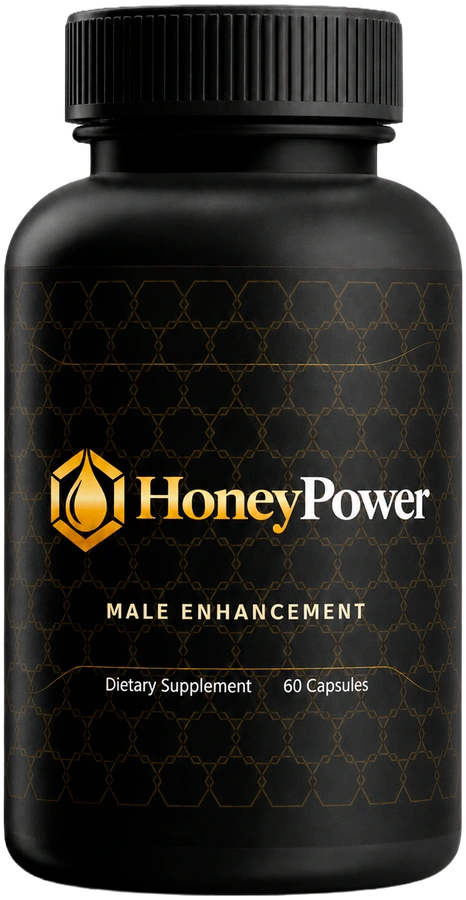
Two capsules a day, 60 to a bottle, and 180 days from purchase to decide on what you wrote down.
One bottle $69 · six bottles $294 · 180-day money-back guarantee
Order HoneyPower On The Official WebsiteTwo capsules a day · 60 per bottle · lot HON-26/MY-5579