HoneyPower Official Website › Benefits
BenefitsWhat Are the Benefits of HoneyPower? Five Key Areas
HoneyPower may support five areas for healthy adult men: performance, energy and endurance, drive, general male wellness and confidence.
The panel prints nine benefit lines that group into these five ideas. Ginseng has the strongest human research of anything listed, at doses in grams.
For when changes may show, see the HoneyPower results timeline.
Every line quoted, the idea under each, and what has been measured.
Written by the HoneyPower Team at MyhoneypowerMedical review: Dr. Shawn Blick, MDRevised
The nine benefit lines printed beside HoneyPower
Nine lines, quoted whole, with the idea each one carries.
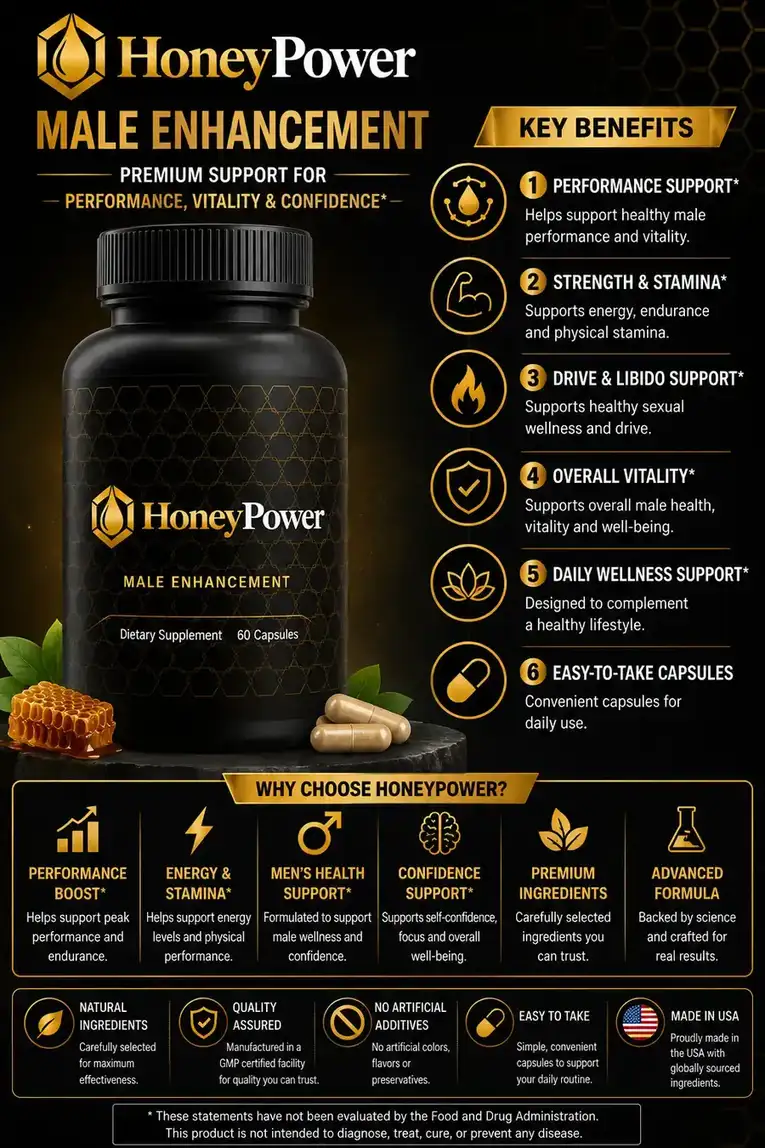
The seller’s overview panel carries nine lines of benefit wording, each with an asterisk tied to the disclaimer printed at the foot of the same panel. They are quoted below in full, because a site that summarises a seller’s claims is deciding for the reader which ones counted.
Read together they cover five distinct ideas rather than nine: performance, energy, drive, general wellness and confidence. Three of the nine restate the energy theme in different words, which is ordinary for a benefits panel and worth noticing before counting them as nine separate promises.
| Line as the panel prints it | The idea underneath | What sits under it |
|---|---|---|
| “Helps support healthy male performance and vitality” | Male performance and vitality | The broadest line on the panel and the hardest to attach to a measurement. Vitality has no endpoint in the literature, so nothing here can confirm or contradict it. |
| “Supports energy, endurance and physical stamina” | Energy, endurance and stamina | The line with the most human work behind it, all of it ginseng’s. Fatigue trials ran at 1 to 2 grams a day across eight weeks and longer. |
| “Supports healthy sexual wellness and drive” | Sexual wellness and drive | Maca’s two randomised desire trials sit here, at 1.5 and 3 grams a day, with an effect that appeared cleanly only at the higher arm. |
| “Supports overall male health, vitality and well-being” | Overall male health and well-being | A general wellness line. It is the sort of claim a supplement is allowed to make and the sort no trial is designed to test. |
| “Designed to complement a healthy lifestyle” | Complementing a healthy lifestyle | Not a claim about the capsule at all. It describes where the product is meant to sit. |
| “Helps support peak performance and endurance” | Peak performance and endurance | A restatement of the second line in athletic language. The tribulus sports trials are the nearest measurements and they found no strength or body composition change. |
| “Helps support energy levels and physical performance” | Energy levels and physical performance | The third restatement of the energy theme. Nine lines cover five distinct ideas. |
| “Formulated to support male wellness and confidence” | Male wellness and confidence | Confidence is a subjective outcome and it is the one buyers most often describe changing first, which is also why it is the hardest to attribute. |
| “Supports self-confidence, focus and overall well-being” | Self-confidence, focus and well-being | Focus appears once, here, and nothing on the panel has a cognitive trial behind it. |
The left-hand column is quoted from the artwork. The right-hand column is this desk’s reading of the published research for each idea.
What sits under each HoneyPower claim
Four ideas, and the human work behind each of them.
Support claims are the language a dietary supplement is allowed to use, and they are deliberately softer than a treatment claim. That does not make them empty. It makes them worth checking one by one against what has actually been measured.
Energy and endurance
The strongest of the five. Ginseng has been trialled in chronic fatigue, rheumatic disease fatigue and cancer-related fatigue at 1 to 2 grams a day. Honey contributes carbohydrate. The most recent honey endurance trial found no performance benefit, which is worth setting beside the athletic framing.
Drive and sexual wellness
Maca carries this one on a randomised desire trial and a dose-comparison trial, with a systematic review calling the evidence limited. Ginseng adds the Cochrane review of nine erectile trials. Both at doses in grams.
Performance and stamina
Tribulus is the ingredient usually attached to this idea and the sports literature is unhelpful to it. Five weeks at 450 mg in elite rugby players produced no difference, and a resistance training trial found the same. A maca trial in cyclists is the other measurement in this area.
Confidence and well-being
Subjective, unmeasured, and the outcome buyers most often name first. Nothing on the panel has a trial with a confidence endpoint, so this line stands as the seller’s wording and as a pattern in customer feedback rather than as a finding.
What HoneyPower is not claiming
Two phrases this website quotes and never asserts.
Two phrases circulate in this category and neither appears as an assertion on this website. They are set out here so that a reader knows exactly what he is and is not being told.
“Raises testosterone”
Where the seller uses wording of this kind it is quoted as theirs and attributed. What the research shows runs the other way: Neychev gave tribulus to young men at 10 and 20 mg per kilogram and measured no change in androgen production, and a review of 191 studies behind ten testosterone-booster ingredients found that fewer than a fifth involved humans at all.
“Improves blood circulation”
Not one of the six has a human circulation endpoint. The nearest published work is icariin inhibiting PDE5 in glassware and raising cGMP in cultured cells. The wider literature on supplement ingredient claims is a useful corrective on how far that kind of finding travels.
The distinction this desk keeps is between quoting and asserting. “MALE ENHANCEMENT” is printed on the bottle and is quoted here as label text wherever the label is being described. It is never restated as a description of what the capsule does to a person.
That rule is what makes the rest of this page worth reading. A site that repeats every phrase on a seller’s panel as its own finding has no way to tell a reader which of the nine lines has a trial behind it.
The benefits HoneyPower buyers actually report
Five things that get mentioned, and roughly when.
The feedback this desk holds is summary copy rather than testimony, and it is treated that way on the reviews page. What it is good for is the shape of the pattern rather than any individual sentence.
| What gets mentioned | Roughly when | How firm the pattern is |
|---|---|---|
| Afternoon energy holding up better | Weeks three to six | The most commonly named change, and the one with ingredient evidence behind it |
| Interest returning before performance changes | Weeks four to eight | Named often enough to be a pattern, and entirely subjective |
| Workouts feeling more ordinary rather than heavier | Weeks four and later | Mentioned by the buyers who train. No measurement behind it |
| Confidence, described in various words | Varies widely | The vaguest of the four and the hardest to attribute to a capsule |
| Nothing at all | Through week two, commonly | The most frequent first-month report, and the expected one |
Drawn from the distributor’s own summary figures, which are not verified transcripts and are not evidence.
The bottom row belongs in the table rather than in a footnote. Most buyers report nothing in the first fortnight, the commonest wait is 3–6 weeks, and a man who knows that going in is far less likely to abandon a routine at day ten.
The results timeline sets the same material out week by week, with what is reasonable to expect at each stage.
How to tell a HoneyPower benefit from a coincidence
The one method that answers the question for you rather than for a trial population.
Everything on this page is either a quoted claim, a trial result belonging to an ingredient, or a pattern in customer feedback. None of those three tells a particular man whether the bottle did anything for him, and only one method does.
Write down three numbers before the first capsule, repeat them on day thirty and day sixty, and change nothing else for the first fortnight. The method is set out step by step on the how to take it page, and it takes about five minutes.
The reason it matters more here than on most supplements is the timeline. An effect that arrives at week five, alongside a change in season, a holiday or a new training block, is exactly the kind of thing memory attributes to whatever was bought most recently.
- Afternoon energy on a one-to-ten scale, noted at the same hour.
- Sessions in the past fortnight, counted rather than estimated.
- How the last hard workout felt, in one sentence.
Where the HoneyPower benefit list goes further than the research
Three stretches in the panel, named once.
Nine lines is a generous panel for a formula with six ingredients and no published amounts, and three specific stretches are worth naming.
- Nine lines cover five ideas. Energy appears three times in different words, which makes the panel look broader than it is.
- Focus appears once and nothing on this panel has a cognitive trial behind it.
- The athletic framing sits closest to the tribulus sports trials, which are the measurements least favourable to the product.
- Every line is a support claim about a healthy man, which is the correct category and also the least falsifiable one.
- None of the nine can be checked against an amount, because no amount is printed for any of the six ingredients.
None of that makes the panel dishonest. Support wording is what dietary supplements are allowed to use and nine lines of it is ordinary in this aisle. What it means is that the panel is the weakest evidence on the page, and the ingredient trials linked above are the strongest.
A buyer deciding on this product should weight them in that order rather than the order the packaging presents them in.
HoneyPower benefit questions
What are the benefits of HoneyPower?
Does HoneyPower improve stamina?
Will HoneyPower help with confidence?
Are the HoneyPower benefits proven?
How quickly do HoneyPower benefits appear?
Does HoneyPower work for everyone?
Sources behind the HoneyPower benefit claims
The trials and reviews named beside each idea above.
- Sung and colleagues, 2020 (Complement Ther Med): a randomized, double-blind, placebo-controlled trial of Korean red ginseng in middle-aged adults with moderate chronic fatigue. PubMed record 31987248
- Cho and colleagues, 2024 (Korean J Intern Med): a randomized, double-blind, placebo-controlled trial of Korean red ginseng for fatigue in people with rheumatic diseases. PubMed record 38576235
- Yennurajalingam and colleagues, 2017 (J Natl Compr Canc Netw): a randomized, placebo-controlled trial of Panax ginseng for fatigue in people with advanced cancer. PubMed record 28874596
- Barton and colleagues, 2013 (J Natl Cancer Inst): the N07C2 randomized, double-blind trial of Wisconsin ginseng, Panax quinquefolius, for cancer-related fatigue. PubMed record 23853057
- Lee and colleagues, 2021 (Cochrane Database Syst Rev): the Cochrane review of ginseng for erectile dysfunction. It pooled nine studies in 587 men followed for twelve weeks at most, and the combined effect fell short of the review’s own threshold for a difference a man would notice. PubMed record 33871063
- Toniazzo and colleagues, 2025 (Int J Sport Nutr Exerc Metab): recreationally trained cyclists given a honey-powder carbohydrate and protein supplement rode no better in endurance tests. PubMed record 40812383
- Tartibian and Maleki, 2012 (J Androl): men in eight weeks of hard cycling training took 70 g of natural honey 90 minutes before each session, with seminal plasma cytokines, oxidative stress markers and antioxidants measured. PubMed record 21636735
- Gonzales and colleagues, 2002 (Andrologia): healthy adult men took maca at 1,500 mg or 3,000 mg a day. Their reported sexual desire rose while serum testosterone stayed where it was. PubMed record 12472620
- Zenico and colleagues, 2009 (Andrologia): a randomised, double-blind trial in men with mild erectile dysfunction, using 2,400 mg of dry maca extract a day and rating well-being and sexual performance. PubMed record 19260845
- Shin and colleagues, 2010 (BMC Complement Altern Med): a systematic review gathering the maca trials on sexual function. PubMed record 20691074
- Stone and colleagues, 2009 (J Ethnopharmacol): a small pilot study of maca, physical activity and sexual desire in male athletes. PubMed record 19781622
- Rogerson and colleagues, 2007 (J Strength Cond Res): elite rugby league players took tribulus at 450 mg a day through five weeks of preseason training, and their strength and body composition ended up no different from placebo. PubMed record 17530942
- Antonio and colleagues, 2000 (Int J Sport Nutr Exerc Metab): resistance-trained men took tribulus at 3.21 mg per kg of body weight a day while body composition and exercise performance were tracked. PubMed record 10861339
- Neychev and Mitev, 2005 (J Ethnopharmacol): healthy young men took tribulus at 10 and 20 mg per kg of body weight a day in three doses, roughly 700 to 1,400 mg for a 70 kg man, and their androgen production was measured. It did not change. PubMed record 15994038
- GamalEl Din and colleagues, 2019 (Urologia): a placebo-controlled study of tribulus for erectile dysfunction and urinary symptoms in men with late-onset hypogonadism. PubMed record 30253697
- Balasubramanian and colleagues, 2019 (J Sex Med): a look at popular online testosterone-booster products. Across nineteen ingredients and the 191 studies behind the ten most common, 19% of the research involved people at all, and 46% of the 37 human studies found no change in testosterone. PubMed record 30770069
- Dell’Agli and colleagues, 2008 (J Nat Prod): laboratory work in which icariin derivatives blocked the human PDE5 enzyme in vitro, with no people involved. PubMed record 18778098
- Ning and colleagues, 2006 (Urology): icariin tested on PDE5 activity and cyclic GMP in cultured cavernous smooth muscle cells, not in people. PubMed record 17169663
- Kuchakulla and colleagues, 2021 (Int J Impot Res): a systematic review that held the ingredients of popular testosterone and erection supplements up against the published evidence. PubMed record 32358510
- NIH Office of Dietary Supplements: a plain-language primer on what supplements are, how they are regulated and how to use them safely. ods.od.nih.gov primer
Judge HoneyPower on the numbers you write down
Nine label lines, six botanicals, 60 capsules a bottle, and 180 days from purchase to decide.
One bottle $69 · six bottles $294 · 180-day money-back guarantee
Order HoneyPower On The Official WebsiteTwo capsules a day · 60 per bottle · lot HON-26/MY-5579