HoneyPower Official Website › Blog › Anxiety And Depression
Anxiety, Depression And Erections: The Part A Capsule Does Not Reach
Six botanicals are named on the HoneyPower bottle, and the seller does not sell any of them as a treatment for worry or low mood. That is worth noticing, because the research on erectile function keeps returning to exactly those two things. Anxiety about performing, and depression itself, appear again and again in the literature as both causes and consequences. This article sets out what the trials and reviews say, so that a man weighing a capsule knows what it is not aimed at.
- Sexual performance anxiety is estimated to affect 9 to 25 percent of men and contributes to psychogenic erectile dysfunction and to premature ejaculation.
- A meta-analysis of 49 publications found depression was associated with a 1.39 times higher odds of erectile dysfunction, and erectile dysfunction with a 2.92 times higher odds of depression.
- A Cochrane review of 11 trials in 398 men found group psychotherapy reduced the number of men with persisting erectile dysfunction compared with a waiting list, and group therapy plus sildenafil beat sildenafil alone.
- An umbrella review of 98 meta-analyses found psychological and behaviour-change interventions produced effect sizes comparable to medication, with greater imprecision.
- Evidence for mindfulness in men is thin: a 2019 systematic review found one study on erectile dysfunction.
The loop that starts in the head
Most people imagine an erection as a purely mechanical event, and mechanical factors are indeed a large part of it. But it is also a state that requires a relaxed mind, and anyone who has been told to relax knows how well that works. The research literature gives this a name, sexual performance anxiety, and a rough size.
Pyke reviewed the field in 2020 and estimated from population-representative surveys that sexual performance anxiety affects 9 to 25 percent of men. It contributes to premature ejaculation and to psychogenic erectile dysfunction, meaning difficulty with a mainly psychological origin. The review's own conclusion is that sexual performance anxiety causes or maintains most of the common sexual dysfunctions, which is a strong statement about how much of the problem can start in the head.
Two features of that review are worth carrying forward. First, it points out that sexual performance anxiety is one of the most prevalent sexual complaints and yet has no recognised diagnosis, which is why research into treatment has been minimal. Second, it is candid about the state of the evidence: cognitive behaviour therapy and mindfulness meditation training are recommended on the strength of their proven benefit for other kinds of performance and social anxiety, but controlled studies of them for sexual performance anxiety specifically are lacking. Phosphodiesterase type 5 inhibitors, the prescription class, are effective for psychogenic erectile dysfunction, and the review said no treatment is well proven for the anxiety itself.
The review also speculates about phytotherapies. It lists several plants as having potential, and Panax ginseng appears among a group of proposed nitric oxide boosters. That is best read as a hypothesis for someone to test, and the word the author uses is potential. Ginseng's actual trial record for erectile function is covered in the ginseng dose article, and it is a record about erectile scores rather than about anxiety.
Depression and erections, in both directions
Depression is a different matter from situational anxiety, and the association with erectile function is one of the better-documented links in the field. Liu and colleagues searched Medline, Embase and the Cochrane Library through October 2017 and pooled every study they could find that had examined erectile dysfunction and depression together. They ran two meta-analyses, one in each direction, because the literature was split on which way the arrow points.
| Question | Pooled odds ratio | What was pooled |
|---|---|---|
| Does depression raise the odds of erectile dysfunction? | 1.39 (95% CI 1.35 to 1.42) | 46 publications, 48 studies; heterogeneity high (I² 93.6%) |
| Does erectile dysfunction raise the odds of depression? | 2.92 (95% CI 2.37 to 3.60) | 5 publications, 6 studies; heterogeneity low |
From the meta-analysis abstract. An odds ratio of 1 would mean no association.
The authors were explicit about what the numbers do not show. An odds ratio measures association, and this study could not determine the direction of causality between the two conditions. The heterogeneity in the first analysis was large, which makes the pooled figure harder to generalise, although they reported no significant publication bias and found the result did not change when any single study was removed.
The practical conclusion they drew was a symmetrical one. Patients who report erectile dysfunction should routinely be screened for depression, and patients presenting with depression should routinely be assessed for erectile dysfunction. For an individual man the plain reading is that if low mood and erectile difficulty arrive together, they should be treated as one question rather than two, and that the second odds ratio is the larger, although it rests on only five publications, so a man who has been struggling with erections has good reason to check in on his mood.
The article on prescriptions adds a complication: some of the drugs used to treat depression have their own signal for sexual side effects. Both the illness and its treatment can matter, which is a strong reason for a prescriber to be part of the conversation.
Know what a capsule is and is not aimed at
HoneyPower is a dietary supplement with six named botanicals. It is not sold as a treatment for anxiety or depression, and this page is not medical advice.
One bottle $69 · six bottles $294 · 180-day money-back guarantee
Order HoneyPower On The Official WebsiteTwo capsules a day · 60 per bottle · lot HON-26/MY-5579
What the therapy trials found
If the mind is part of the problem, the natural question is whether working on it helps, and the best summary is a Cochrane review by Melnik, Soares and Nasselo. It searched Medline, Embase, PsycINFO and other sources up to 2007 and included nine randomised and two quasi-randomised trials involving 398 men with erectile dysfunction. Of those, 141 received psychotherapy, 109 medication, 68 psychotherapy plus medication, 20 vacuum devices, and 59 were controls.
The results, as the abstract reports them:
- Group psychotherapy against a waiting list. In five pooled trials with 100 men, group therapy reduced the number of men with persisting erectile dysfunction at the end of treatment (relative risk 0.40, 95 percent confidence interval 0.17 to 0.98). At six months the reduction was maintained (relative risk 0.43, 0.26 to 0.72), though that follow-up covered only 37 men.
- Sex-focused group therapy. In two trials with 37 men, the relative risk of persisting dysfunction was 0.13 (0.04 to 0.43), with a 95 percent response rate against 0 percent for the waiting list control.
- Therapy plus sildenafil against sildenafil alone. In two trials with 71 men, adding group therapy reduced persisting dysfunction (relative risk 0.46, 0.24 to 0.88) and men were less likely to drop out (relative risk 0.29, 0.09 to 0.93).
These are encouraging numbers and they come with the usual small-sample warnings. Several of the trials were decades old, with names in the abstract dated 1975 to 1987 alongside newer ones, and the men in them were not a modern general population. The subgroup figures rest on 37 to 100 men. The reviewers noted that response appeared to vary between patient subgroups, although they found no significant difference in improvement by age, type of relationship or severity. The pattern is nevertheless consistent enough to take seriously: for a problem that has a psychological component, a structured psychological approach has been tested in randomised trials and produced measurable results.
It is worth being honest about the design. These trials ask whether a structured approach beats a waiting list, which is a different and easier question than whether a capsule beats a placebo, so the two sets of numbers should not be laid side by side as if they answered the same thing.
Mindfulness, and how little there is
Mindfulness training is often recommended alongside therapy, and it is worth stating where the evidence actually stands. Jaderek and Lew-Starowicz reviewed the literature in 2019 and found 15 original research articles on mindfulness-based interventions for sexual dysfunction. Four concerned genital-pelvic pain, ten concerned desire or arousal in women, and one concerned erectile dysfunction in men.
The reviewers found that mindfulness led to improvements in arousal, desire and sexual satisfaction and a reduction in fear linked to sexual activity, mostly in women, and that it did not significantly reduce pain during sexual activity. For men they identified evidence of efficacy in one study. They concluded that more research was needed on male sexual dysfunction and that the few available studies had methodological limitations, including small numbers and complex interventions.
That is a thin base, and this article does not pretend otherwise. Mindfulness may help; the honest statement is that it is under-studied in men. It is an example of something you can do for free that the research has barely examined, which is the opposite situation from a capsule with a lot of marketing and a small trial base.
The big picture across 98 meta-analyses
To see where the psychological approaches sit among all the options, the best single source is an umbrella review, a review of reviews. Allen and Walter gathered 98 meta-analyses covering 421 meta-analytic effects, 4,188 primary effects and 3,971,122 participants, and graded the evidence with two quantitative measures.
Their findings, briefly: an unhealthy lifestyle, genetic markers and medical conditions were associated with increased risk of erectile dysfunction. Testosterone therapy and PDE5 inhibitors showed the greatest treatment efficacy, with mild adverse events across treatments. Psychological and behaviour-change interventions produced effect sizes comparable to medication but with greater imprecision. There was little evidence that combined treatments were more effective than single ones. The review provided summary estimates for 37 risk factors and 28 treatments, and it recommended that primary care physicians ask about erectile problems in all men over 40 who present with any health-related issue such as being overweight or smoking.
The authors listed their own limits. Meta-analyses of risk factors often did not control for important confounders, and meta-analyses of randomised trials were not limited to double-blind studies, active placebos or tests of long-term effects. Those caveats matter, and they apply to every sentence above. The overall shape is nevertheless clear: the largest measured treatment effects belonged to prescription therapies, and psychological and behaviour-change interventions were comparable to medication.
What this means for a capsule
None of the above is an argument against buying a supplement. It is an argument for knowing what a supplement is aimed at, so that expectations match.
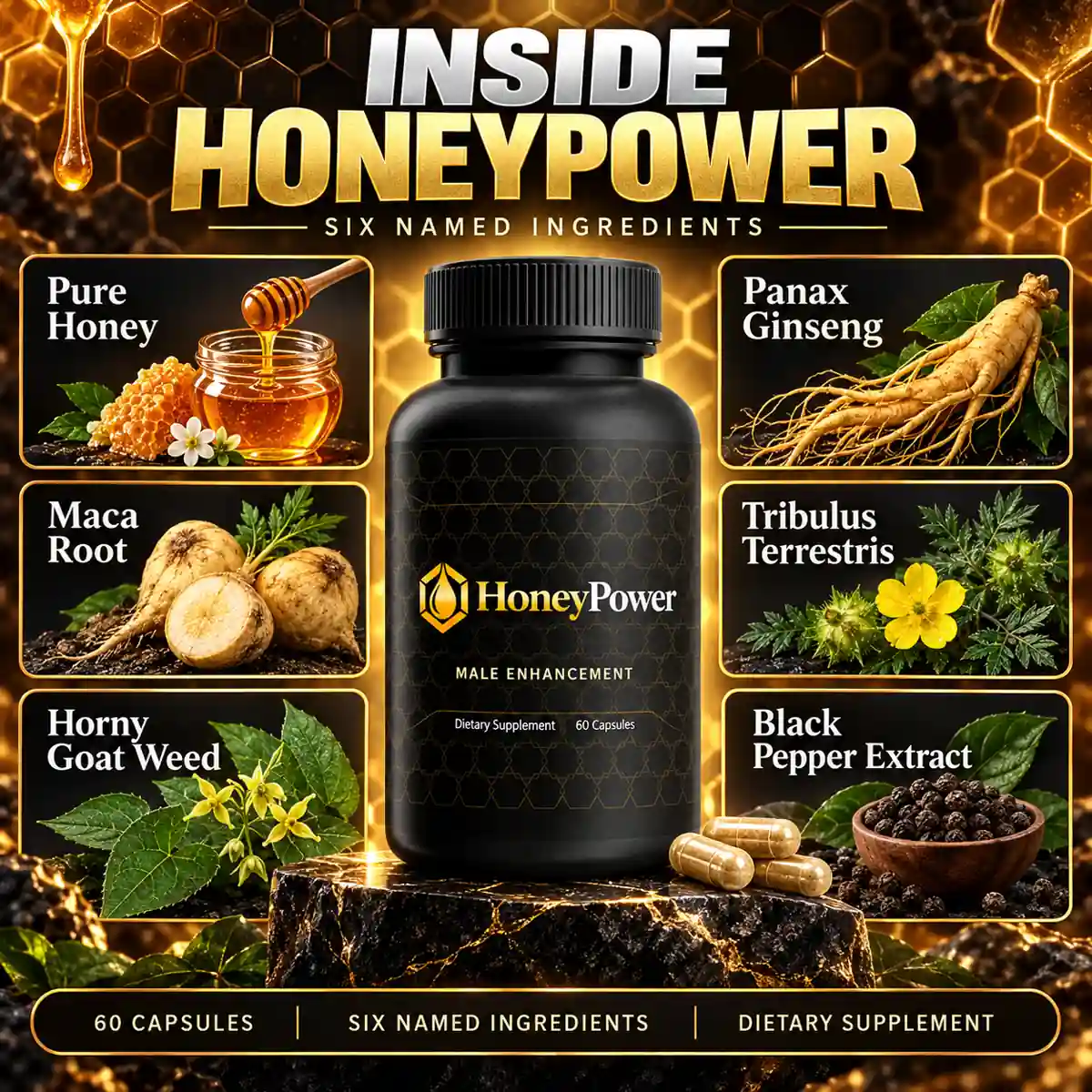
The seller names healthy testosterone, blood circulation, energy and stamina as the things the formula supports. Its benefits panel adds a confidence support line, worded as supporting self-confidence, focus and overall well-being, with the standard asterisk and the statement that the product is not intended to diagnose, treat, cure or prevent any disease. That is general wellbeing wording, not a claim about anxiety or depression. The product names six ingredients, prints no amount for any of them, and asks for two capsules a day. A man whose main difficulty is anxiety, or whose difficulty arrived with depression, is therefore likely to be looking at the wrong tool for that part of the problem, however good the capsule.
The related point is one the placebo article makes from the other side: in a condition with a large psychological component, expectation is powerful. A capsule taken with hope can produce some improvement by that route, and it is worth being aware of when judging any result. That is not an accusation against the capsule. It is a reason to keep a baseline and a fixed span, and to give an honest answer when asked what caused what.
For the general skill of reading a label that names ingredients without amounts, the article on reading a label that prints no amounts is the place to start, and the ingredients page sets each name beside its research dose.
When to talk to someone
If erectile difficulty has appeared alongside a persistent low mood, loss of interest in things you used to enjoy, sleep that has changed, or anxiety that is hard to put down, that combination deserves a proper conversation with a doctor or a mental health professional, and it deserves it more than it deserves a fourth bottle of anything. The Liu meta-analysis recommends screening in both directions for exactly that reason. It is also worth raising if the difficulty started after a specific event, a loss, a period of heavy stress or a change in a relationship, because that timing is information in its own right.
The side effects page covers the two documented interactions on this label, which matter for anyone who has been prescribed medicine for mood or anxiety. This website is a retail desk and cannot advise on treatment, and nothing on it is a substitute for an assessment.
Four questions worth asking yourself
- Is it every time, or only in some situations? Difficulty that varies with pressure or circumstance points somewhere different from difficulty that is constant.
- What is my mood, honestly? The meta-analysis found the link is strong enough that the question is routine.
- Did it start with a specific event? A loss, a stressful period or a change in a relationship is worth saying out loud to whoever you see.
- What is a capsule aimed at? Here, a general supplement positioning around testosterone, circulation, energy, stamina and confidence, none of which is a treatment for worry or depression.
Sexual performance anxiety affects roughly one man in four to one in eleven, depression and erectile dysfunction travel together in both directions, and structured psychological therapy has beaten a waiting list in randomised trials. The six botanicals on this bottle are not sold as treatments for anxiety or depression, and in the umbrella review the largest measured effects belonged to prescription therapies, with psychological approaches comparable to medication. If the difficulty has a mental component, that is where the attention belongs first.
References
- Allen MS, Walter EE. Erectile Dysfunction: An Umbrella Review of Meta-Analyses of Risk-Factors, Treatment, and Prevalence Outcomes. J Sex Med. 2019;16(4):531-541. PMID 30833150. https://pubmed.ncbi.nlm.nih.gov/30833150/
- Jaderek I, Lew-Starowicz M. A Systematic Review on Mindfulness Meditation-Based Interventions for Sexual Dysfunctions. J Sex Med. 2019;16(10):1581-1596. PMID 31570137. https://pubmed.ncbi.nlm.nih.gov/31570137/
- Liu Q, Zhang Y, Wang J, Li S, Cheng Y, Guo J, et al. Erectile Dysfunction and Depression: A Systematic Review and Meta-Analysis. J Sex Med. 2018;15(8):1073-1082. PMID 29960891. https://pubmed.ncbi.nlm.nih.gov/29960891/
- Melnik T, Soares BG, Nasselo AG. Psychosocial interventions for erectile dysfunction. Cochrane Database Syst Rev. 2007;2007(3):CD004825. PMID 17636774. https://pubmed.ncbi.nlm.nih.gov/17636774/
- Pyke RE. Sexual Performance Anxiety. Sex Med Rev. 2020;8(2):183-190. PMID 31447414. https://pubmed.ncbi.nlm.nih.gov/31447414/