HoneyPower Official Website › Blog › Black Maca Vs Red Maca
Black Maca vs Red Maca: Does The Color Matter?
Maca root is sold in black, red and yellow varieties, and the search traffic asking whether the color on the label matters is real and specific. It also has a real answer: a 175-person randomized trial gave black and red maca side by side for twelve weeks, and the two extracts did not produce identical results.
- A 2016 randomized, double-blind, placebo-controlled trial gave 175 people 3 grams a day of black maca, red maca or placebo for 12 weeks.
- Both varieties improved mood, energy and quality-of-life scores versus placebo, but the improvement in mood, energy and mountain-sickness scores was reported as better with red maca specifically.
- Black maca extract contained more total polyphenols and macamides than red maca extract in the same trial’s chemical analysis; red maca extract was higher in GABA.
- The dose-finding trial this site’s sister article on maca is built around used “Maca Gelatinizada” with no color variety specified at all.
- Most of the color-specific animal research splits by use rather than running every variety through every test: red maca is the most-studied variety for prostate size, black maca for learning and memory.
Why the color question is worth asking
Maca root comes in a genuine range of hypocotyl colors — cream, yellow, red, purple and black are all documented varieties of the same species, Lepidium meyenii, grown at altitude in the Peruvian Andes. Search demand for the difference between them is real and specific: people ask directly whether black maca outperforms yellow, and whether red and yellow behave differently. That is a fair question, because unlike most of the label-reading questions on this website, this one has an actual head-to-head trial behind it rather than just a dose comparison.
The trial that tested black and red side by side
a 2016 randomized, double-blind, placebo-controlled study is the most directly relevant piece of evidence available on this question. Gonzales-Arimborgo and colleagues gave 175 adult participants, split across low- and high-altitude sites in Peru, 3 grams a day of spray-dried extract of either black maca, red maca, or placebo for 12 weeks.
| Outcome measured | What the trial reported |
|---|---|
| Mood, energy, health-related quality of life | Both black and red maca improved these versus placebo |
| Chronic mountain sickness score | Reduced by maca; the improvement was reported as better with red maca |
| Blood glucose | Reduced by black maca specifically |
| Hemoglobin (in highlanders with abnormally high levels) | Reduced by black maca, and to a smaller degree by red maca; neither affected lowlanders’ hemoglobin |
| Safety and tolerability | Both extracts well tolerated at both altitudes, no serious adverse effects reported |
Same species, same 3 g dose, twelve weeks, two colors, and the two colors did not produce an identical result sheet.
The authors’ own conclusion states plainly that differences in the level of improvement between red and black maca are probably explained by differences in the chemical composition of the two varieties, which is the question the next section addresses directly. One disclosure is worth naming here in the spirit of this website’s usual practice: the trial’s senior author is also the manager of a small nutraceutical company, a conflict the paper itself discloses. That does not overturn a randomized, placebo-controlled, double-blind design, but it is the kind of detail this desk prints rather than omits.
What is actually different inside the two colors
a separate 2016 chemical and biological comparison measured total polyphenol content in both black and red maca extracts directly, alongside antioxidant activity and several in-vivo outcomes in mice. Black maca extract contained a significantly higher total polyphenol content than red maca extract in the same comparison. The 2016 human trial above reported a parallel pattern in a different compound class: fatty acids and macamides ran higher in black maca’s spray-dried extract, while GABA predominated in red maca’s.
That is the mechanistic thread connecting the two studies. Different pigmentation in maca hypocotyls tracks with a different balance of the plant’s own bioactive compounds, not merely a cosmetic difference, which is consistent with the human trial finding that the two colors’ effects were similar on some outcomes and different on others rather than identical across the board.
Red maca’s best-studied use: the prostate literature
Outside the head-to-head human trial, most of the maca color-specific research has been run one variety at a time against one outcome, rather than comparing every color against every endpoint. Red maca’s most consistent line of published research concerns prostate size in animal models.
a 2008 study in adult mice induced prostatic hyperplasia with testosterone enanthate, then treated the animals with red maca or with finasteride, a prescription 5-alpha-reductase inhibitor, as a positive control. Red maca reduced prostate weight by a factor of roughly 1.59 at 21 days and reduced prostatic stroma area by a factor of roughly 1.42, without affecting testis, epididymis or seminal vesicle weight.
That is a mouse study, not a human trial, and it should be read as exactly that: preclinical evidence that red maca specifically, rather than maca in general, has been the color researchers reach for when the outcome being studied is prostate size.
Black maca’s best-studied use: the memory literature
a 2007 study in male mice ran the same logic in the other direction. Rubio and colleagues gave black maca extract for 35 days before inducing memory impairment with scopolamine, then tested learning and memory using the Morris water maze and a step-down avoidance test. Both aqueous and hydroalcoholic extracts of black maca meaningfully improved the scopolamine-induced memory deficit, and the extracts inhibited brain acetylcholinesterase activity, a plausible mechanism for the effect.
The same research group had previously reported black maca performing better than other maca varieties on a water-finding memory test in ovariectomized mice, which is the reason black maca rather than red or yellow became the variety of choice for this line of work. Again: mice, not people, and a different endpoint from the prostate research above.
See how HoneyPower names its maca root
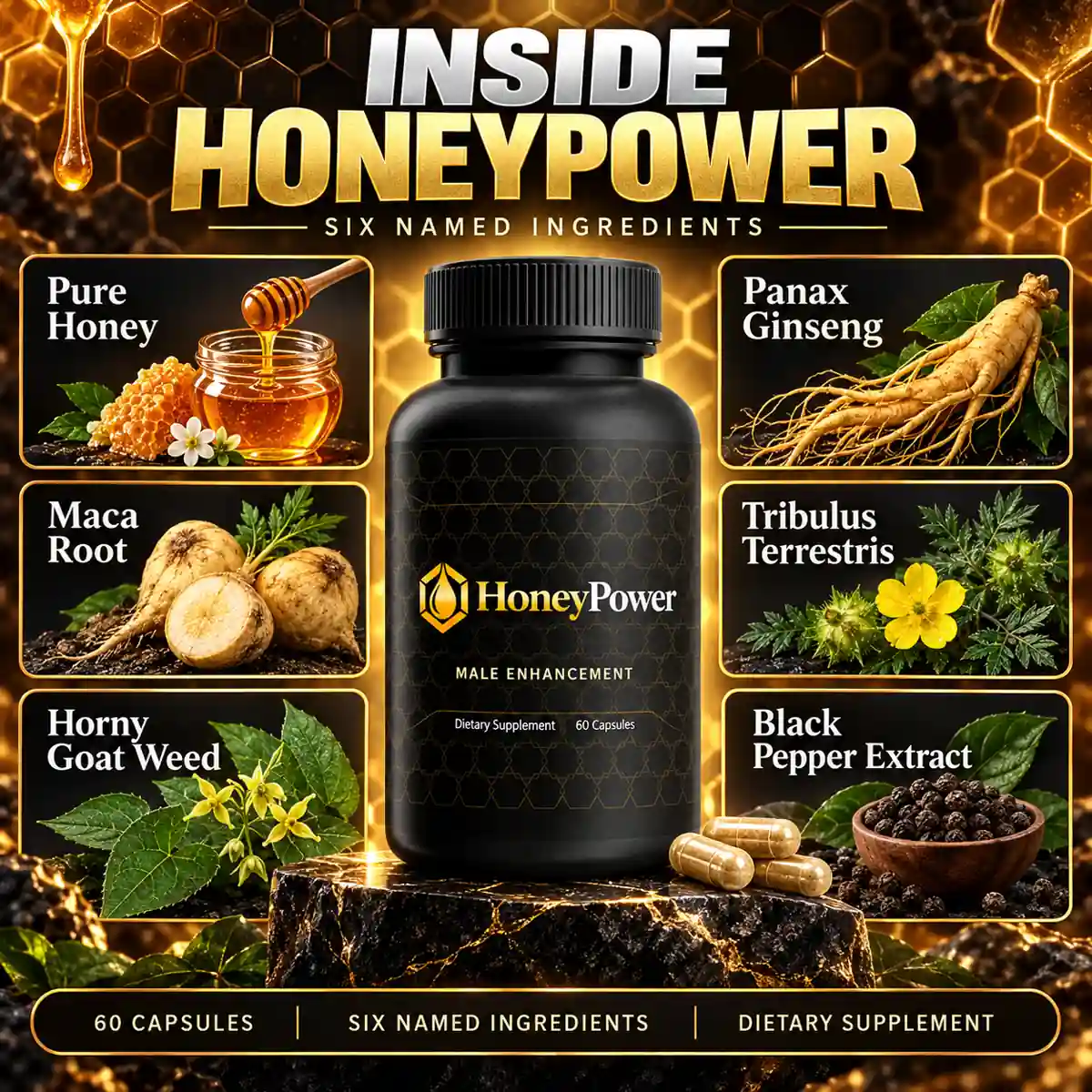
The seller lists maca root third of six ingredients, with no color variety and no gram figure stated. This desk prints the color-specific literature beside that silence rather than guessing which variety is inside.
One bottle $69 · six bottles $294 · 180-day money-back guarantee
Order HoneyPower On The Official WebsiteTwo capsules a day · 60 per bottle · lot HON-26/MY-5579
The trial this network already leans on used neither color
This point is worth making explicitly because it cuts against a simple story. the dose-finding trial that this network’s coverage of maca elsewhere is built around — the twelve-week study that compared 1,500 mg and 3,000 mg a day and found the higher dose improved self-reported sexual desire with no change in serum testosterone — used a preparation the paper names only as “Maca Gelatinizada.” No color variety is specified anywhere in the published method.
That is not a criticism of the trial; gelatinized maca is a standard processing method (a way of pre-cooking the starchy root to make it more digestible) independent of which color hypocotyl went into it, and the trial was answering a dose question, not a variety question. But it does mean the best-known human dose-response data in this category cannot itself answer whether color changes the result. Only the 2016 black-versus-red trial above speaks directly to that, and it did so on different outcomes than sexual desire.
What a bare “maca root” row leaves open
Put the studies together. A direct human comparison found black and red maca both effective on some outcomes and different from each other on others, tied to a measurable difference in polyphenol, macamide and GABA content between the two colors. Red maca is the variety with the deepest preclinical record on prostate size; black maca is the variety with the deepest preclinical record on memory. And the specific dose-response trial most often cited for maca’s general sexual-desire effect used a preparation with no stated color at all.
A label that reads “Maca Root” with nothing else printed has not told a reader which of these bodies of evidence, if any, applies to what is actually in the capsule. It has told a reader the genus and species only.
It is worth being honest about the size of that gap rather than overstating it. The 2016 trial is a real randomized, placebo-controlled human study, which puts it ahead of almost everything else in this article, but it is one trial from one research group, run at one dose, for one duration. It answers “does color change the result on these specific outcomes, at 3 grams a day, for 12 weeks” reasonably well. It does not answer whether color changes the result for sexual desire specifically, because that was not one of its measured endpoints, and it does not establish an optimal dose for either color the way a dedicated dose-finding trial would. Readers who want a single number to carry to a shelf should treat the color question and the dose question as two separate, only partially answered questions, not one settled answer.
Four questions worth asking of any maca row
- Which color? Black, red and yellow are documented as chemically distinct, not just visually distinct.
- What outcome is being implied? The prostate literature leans red; the memory literature leans black; neither literature is about sexual desire specifically.
- Is the dose-response evidence being cited actually color-specific? The 1,500 mg/3,000 mg desire trial used an unspecified-color gelatinized preparation.
- Is the source human or animal evidence? The head-to-head color trial is human. Most of the mechanism-specific color research below it is mouse.
Maca’s color is not decorative. A 175-person human trial found black and red maca extracts measurably different in composition and not identical in effect, and the two colors have separately accumulated different preclinical literatures — red for prostate size, black for memory. The most commonly cited maca dose-response trial in this whole product category, meanwhile, never named a color at all. A label that says only “Maca Root” is silent on the one variable in this ingredient’s own research that the research itself treats as real.
References
- Gonzales-Arimborgo C, Yupanqui I, Montero E, Alarcón-Yaquetto DE, Zevallos-Concha A, Caballero L, Gasco M, Zhao J, Khan IA, Gonzales GF. Acceptability, Safety, and Efficacy of Oral Administration of Extracts of Black or Red Maca (Lepidium meyenii) in Adult Human Subjects: A Randomized, Double-Blind, Placebo-Controlled Study. Pharmaceuticals (Basel). 2016;9(3):49. PMID 27548190. Dose: 3 g a day of black, red or placebo extract for 12 weeks, 175 participants. https://pubmed.ncbi.nlm.nih.gov/27548190/
- Gonzales GF, Córdova A, Vega K, Chung A, Villena A, Góñez C, Castillo S. Effect of Lepidium meyenii (MACA) on sexual desire and its absent relationship with serum testosterone levels in adult healthy men. Andrologia. 2002;34(6):367-72. PMID 12472620. Dose: 1,500 mg or 3,000 mg a day of Maca Gelatinizada; color not specified. https://pubmed.ncbi.nlm.nih.gov/12472620/
- Gonzales GF, Gasco M, Malheiros-Pereira A, Gonzales-Castañeda C. Antagonistic effect of Lepidium meyenii (red maca) on prostatic hyperplasia in adult mice. Andrologia. 2008;40(3):179-85. PMID 18477205. https://pubmed.ncbi.nlm.nih.gov/18477205/
- Rubio J, Dang H, Gong M, Liu X, Chen SL, Gonzales GF. Aqueous and hydroalcoholic extracts of Black Maca (Lepidium meyenii) improve scopolamine-induced memory impairment in mice. Food Chem Toxicol. 2007;45(10):1882-90. PMID 17543435. https://pubmed.ncbi.nlm.nih.gov/17543435/
- Zevallos-Concha A, Nuñez D, Gasco M, Vasquez C, Quispe M, Gonzales GF. Effect of gamma irradiation on phenol content, antioxidant activity and biological activity of black maca and red maca extracts (Lepidium meyenii walp). Toxicol Mech Methods. 2016;26(1):67-73. PMID 26633045. https://pubmed.ncbi.nlm.nih.gov/26633045/