HoneyPower Official Website › Blog › Icariin In The Lab
Icariin: The Test Tube And The Bedroom
Icariin, the compound behind horny goat weed, inhibits PDE5 in glassware. That is a real finding and it is the reason the ingredient is on so many labels. What nobody has done is test it against an erection endpoint in a person.
- Icariin inhibits human PDE5 in vitro. That is the same enzyme prescription erectile medicines target.
- It also raises cyclic GMP in cultured cavernous smooth muscle cells.
- Both of those are laboratory findings. Neither involved a person.
- The only human trial of isolated icariin this desk could find ran open-label in a mood disorder, at 300 mg a day, and measured mood.
- The NIH LiverTox chapter records that the sexual-function effects have not been proven in rigorous prospective controlled trials.
What the laboratory work actually shows
The science here is real and it is worth understanding before it is criticised.
PDE5 is an enzyme that breaks down cyclic GMP, the signalling molecule that keeps smooth muscle in the penis relaxed during an erection. Prescription erectile medicines work by inhibiting it, so cyclic GMP persists and the erection is maintained. That is a well characterised, well understood pathway.
Dell’Agli and colleagues tested icariin derivatives against human PDE5 in the laboratory and found potent inhibition. Ning and colleagues went a step further, working with cultured cavernous smooth muscle cells, and found icariin affected PDE5 activity and raised cyclic GMP in them.
So the compound does what the mechanism story says it does, in the settings where it has been tested. Nothing in this article disputes that.
Where a laboratory result stops being transferable
The distance between a dish and a person is made of three separate problems, and a compound has to survive all three. It has to be absorbed from the gut in a useful quantity. It has to survive first-pass metabolism in the liver, which is designed to dismantle exactly this sort of molecule. And it has to arrive at the target tissue at a concentration comparable to the one that worked in the dish.
A glassware experiment answers none of those, because the compound is applied directly to the enzyme at a concentration the researcher chose. That is not a flaw in the experiment; it is what the experiment is for. It is a flaw in any sentence that presents the result as though a swallowed capsule reproduced it.
The evidence ladder, rung by rung
Drug development is a ladder and most compounds fall off it. Laying the rungs out is the clearest way to see where an ingredient actually stands.
| Rung | What it establishes | Where icariin sits |
|---|---|---|
| Enzyme in glassware | A compound can interact with a target | Established. Dell’Agli 2008 |
| Cell culture | The interaction survives in living cells | Established. Ning 2006 |
| Animal model | Something happens in a whole organism | Some work exists |
| Human trial, relevant endpoint | It happens in people, for the thing being claimed | Not found. No human erection trial of isolated icariin |
| Randomised, placebo-controlled | It is not the placebo effect or chance | Not found |
| Systematic review | The finding survives being pooled with everything else | Nothing to pool |
The evidence ladder, rung by rung. An ingredient can be genuinely interesting on the first two and still have nothing on the fourth.
Icariin is firmly on the first two rungs and has nothing on the fourth. That is not a rare position: the great majority of compounds that inhibit an enzyme in glassware never show a clinical effect, because reaching the tissue at a sufficient concentration after being swallowed is a separate and much harder problem.
The gap between rung two and rung four is where most supplement marketing lives, and it is worth being able to spot from the language alone. “Works by inhibiting PDE5” is a rung-one sentence being presented as a rung-five one.
The one human trial, and what it measured
There is a human trial of isolated icariin and it is not what anybody would expect.
Xiao and colleagues ran an open-label pilot study of icariin in people with co-morbid bipolar and alcohol use disorder, at up to 300 mg a day for eight weeks. The endpoint was mood.
Three things about that design matter. It was open-label, so everybody knew what they were taking. It had no placebo arm. And it was not measuring anything to do with erections, because that was not what it was for.
It is a legitimate pilot study and it is cited here because it is the only human dosing figure that exists for this compound. What it is not is evidence for the claim the ingredient is sold under.
See how HoneyPower handles the ingredients with the thinnest evidence
Six named botanicals, each set beside what its own human research actually used, including the two where that research barely exists.
One bottle $69 · six bottles $294 · 180-day money-back guarantee
Order HoneyPower On The Official WebsiteTwo capsules a day · 60 per bottle · lot HON-26/MY-5579
What the NIH chapter says out loud
The clearest statement on this ingredient comes from a source with nothing to sell.
The NIH LiverTox chapter on horny goat weed gives it likelihood score E, an unlikely cause of clinically apparent liver injury, which is reassuring. It also records two things a label never will: the usual commercial product is one 250 mg or 500 mg capsule a day, and the sexual-function effects have not been proven in rigorous prospective controlled trials.
That second sentence is a federal evidence review stating plainly what this article has taken several sections to establish. There is also mechanistic work on Epimedium and the liver, which sits alongside the E grade rather than overturning it and is worth knowing about for anyone taking large amounts of a single-ingredient product.
Why a mechanism story is so persuasive
It is worth asking why this particular kind of claim works so well, because recognising the pattern is more useful than memorising one ingredient.
A mechanism story is satisfying in a way a trial result never is. It has a beginning and an end, it explains rather than merely reports, and it flatters the reader by treating him as somebody who can follow an argument. “It inhibits the same enzyme the prescription does” is a complete, coherent, memorable sentence.
A trial result is the opposite. It is a number with a confidence interval attached, it usually disappoints, and it cannot be retold at a dinner table. An analysis of what is actually marketed for erectile dysfunction found the gap between mechanism and outcome is a structural feature of this category rather than an accident.
The practical defence is one question, asked every time: was this measured in people, for the thing being claimed?
The question a man on ED medication should ask
There is a practical consequence of the mechanism above, and it is the one genuinely actionable thing in this article.
If icariin inhibits PDE5, and a prescription medicine inhibits PDE5, then in principle they act on the same target. Nobody has studied the combination in people, so nothing here is a documented interaction, and the amounts in a six-ingredient capsule are almost certainly small.
But “almost certainly small” is an inference about an unstated quantity, and the right move is to mention the capsule at the appointment rather than to work it out yourself. A urologist’s guide to what is in men’s sexual-health products is written for exactly that conversation.
What horny goat weed is not being accused of
The plant has been used for a very long time and nothing here suggests it is inert, harmful or fraudulent.
Its liver grade is reassuring. Its mechanism work is genuine science published in peer-reviewed journals. And an ingredient without a human trial is not an ingredient that failed one; it is an ingredient nobody has funded a trial for, which is a statement about research economics rather than about the plant.
What this article argues is narrower. A page that cites the glassware work beside a bedroom claim has skipped three rungs of a ladder, and a reader who knows the rungs can see it happening.
Four questions worth asking of any icariin row
- Is the amount printed, and is it icariin or whole-plant extract? Those are different materials at very different concentrations.
- Does the page cite a human trial with a relevant endpoint? For this compound, none exists.
- Does it describe the PDE5 mechanism as though it were a clinical result?
- Are you taking a prescription erectile medicine? If so, the capsule is worth mentioning at the appointment.
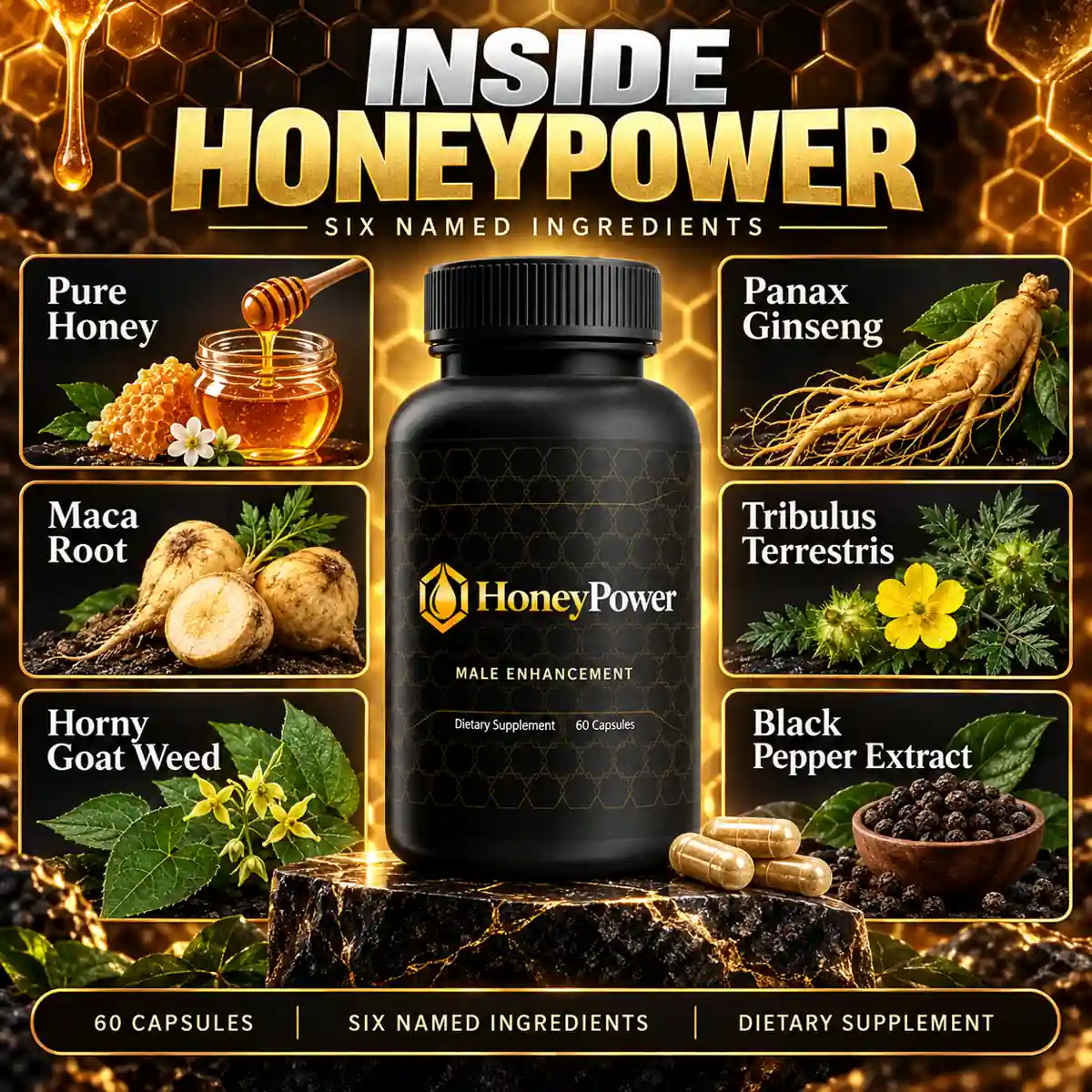
On the bottle this website sells, no amount is printed and no form is stated, which on this ingredient changes less than it does on the others, because there is no established human dose to compare anything with. The rest of the panel is set out on the ingredients page.
The last article in this series is how to read a label that prints no amounts, which is the general skill the other four are worked examples of.
References
- Dell’Agli and colleagues, 2008 (J Nat Prod): laboratory work in which icariin derivatives blocked the human PDE5 enzyme in vitro, with no people involved. PubMed record 18778098
- Ning and colleagues, 2006 (Urology): icariin tested on PDE5 activity and cyclic GMP in cultured cavernous smooth muscle cells, not in people. PubMed record 17169663
- Xiao, Wignall and Brown, 2016 (Am J Drug Alcohol Abuse): an open-label pilot study giving icariin at up to 300 mg a day for eight weeks to people with bipolar disorder and alcohol use disorder. It had no erection endpoint. PubMed record 26809351
- Cui and colleagues, 2015 (J Sex Med): a urologist’s walk-through of the ingredients found in best-selling men’s sexual health products. PubMed record 26531010
- LiverTox (NIDDK), horny goat weed chapter, updated 8 August 2022: likelihood score E, an unlikely cause of clinically apparent liver injury. The chapter puts the usual product at one 250 mg or 500 mg capsule a day and says its sexual-function effects have not been proven in rigorous prospective controlled trials. NCBI Bookshelf NBK583203
- Li and colleagues, 2022 (Front Pharmacol): a metabolomics study of how Epimedium koreanum can injure the liver. PubMed record 35910368
- Petre and colleagues, 2023 (Nutrients): products sold for erectile dysfunction, analysed alongside a systematic review and meta-analysis of their ingredients and advice on sensible use. PubMed record 37686709