HoneyPower Official Website › Blog › Honey In A Capsule
How Much Honey Is Actually In A Honey Capsule?
Honey is eaten by the spoonful and every human trial behind it was run that way. A capsule holds a few hundred milligrams of everything it contains. That gap is the first thing worth understanding about any product with honey in its name.
- Human trials of honey ran at 50 to 84 grams a day, and one used 70 grams before every training session.
- A tablespoon of honey is about 21 grams. The smallest trial dose is two and a half of them.
- A two-capsule serving carrying six ingredients cannot hold a gram of any one of them, let alone fifty.
- The honey trials measured metabolic markers, oxidative stress and athletic performance. None of them measured male vitality.
- The most recent one found a honey-powder product did not improve endurance cycling performance at all.
Honey is a spoonful food
Nobody has ever taken honey in milligrams. It goes into tea, onto toast and into a mixing bowl, and the unit everybody uses without thinking about it is the tablespoon, which holds roughly 21 grams.
That matters more than it sounds, because the entire human research literature on honey was built at the doses people actually eat. Researchers did not invent a new quantity to study; they took the amount a person might reasonably consume and measured what happened.
So when a capsule carries honey as its lead ingredient and its brand name, the first honest question is not whether honey is good for you. It is how much of it is in there, and whether that quantity has any relationship to the quantity anyone has studied.
What the human honey trials actually gave
Five human studies sit behind most of what gets claimed for honey, and every one of them states its dose plainly.
| Trial | What it gave | Over how long | What it measured |
|---|---|---|---|
| Raatz 2015 | 50 g of carbohydrate from honey a day | 14 days | Glucose and metabolic markers, against sucrose and corn syrup |
| Tartibian 2012 | 70 g of honey, 90 minutes before each training session | 8 weeks | Seminal plasma cytokines and oxidative stress markers in trained cyclists |
| Al-Tamimi 2020 | 1.2 g of carbohydrate per kg of body weight per day, as honey | 4 weeks, crossover | Blood lipids in adult men and women |
| Hajizadeh Maleki 2016 | Honey supplementation alongside cycling training | 16 weeks | Lymphocyte oxidative stress and antioxidant parameters |
| Toniazzo 2025 | A honey-powder carbohydrate and protein product | Crossover | Endurance cycling performance. It found no improvement |
Doses read off each paper, not recalled. A 1.2 g/kg dose for an 80 kg man is about 96 g of carbohydrate a day.
Read the second column downward. Fifty grams a day for a fortnight is the floor. Seventy grams before every training session for eight weeks is the athletic study most often cited in men’s products. One-point-two grams per kilogram of body weight daily works out at 84 grams for a seventy-kilogram man and nearly a hundred for a large one.
Nothing in that literature used a fraction of a gram, because nothing in that literature was testing a capsule.
What those amounts look like on a kitchen table
Grams on a page are abstract. Put them next to something familiar and the position becomes obvious without anybody having to argue it.
| Quantity | What it looks like | Where it appears |
|---|---|---|
| 84 g | About four tablespoons of honey | The upper end of the human trial doses |
| 50 g | About two and a half tablespoons | The lowest dose any of these trials used |
| 21 g | A single tablespoon | A quarter of the way to the smallest trial dose |
| 1 g | A quarter teaspoon | More than a two-capsule serving can hold of one ingredient when it holds six |
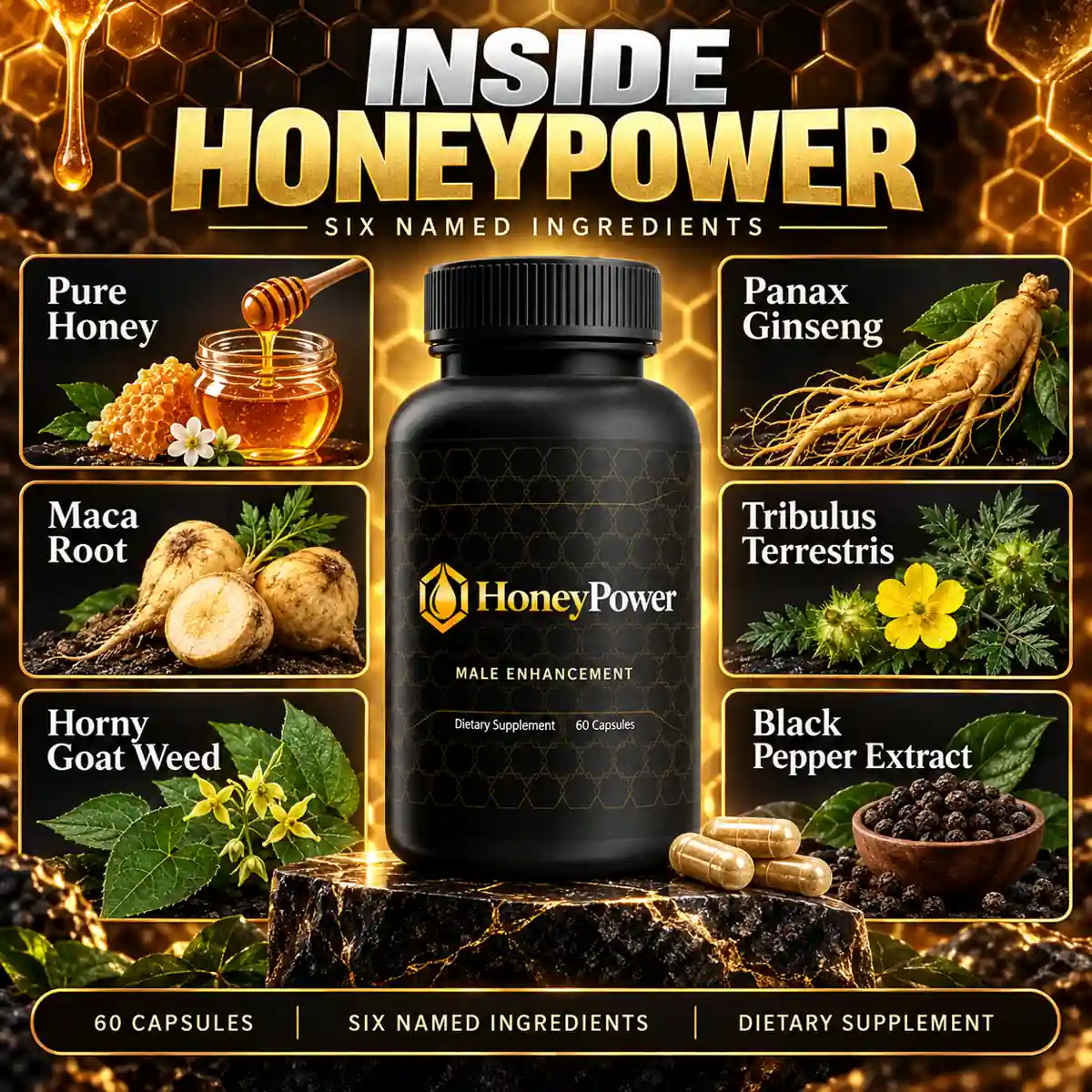
| Unstated | Whatever is in the capsule | What this artwork prints for honey, and for the other five |
The last row is the only one that describes this product, and it is the reason the other four are here.
A two-capsule serving of a typical botanical supplement carries somewhere between four hundred milligrams and a gram and a half in total, and on this product that total has to be shared between six ingredients. Even if honey took the largest share, it would be a small fraction of one tablespoon.
What a capsule can physically hold
This is an engineering constraint rather than a marketing decision, and it applies to every capsule product ever made.
The size of the shell
A standard size 0 capsule, which is what most supplements use, holds roughly 400 to 500 mg of powdered botanical material depending on density. A size 00 holds more, around 700 to 800 mg, and is noticeably harder to swallow. Two capsules therefore carry somewhere between 0.8 and 1.6 grams of total material.
What happens when six ingredients share it
Divide that by six and the average share is 130 to 270 mg. Formulas are rarely divided evenly, so the lead ingredient may take more and the last may take very little, but no arithmetic gets any single one of them to fifty grams. It is not close, and no amount of extraction or concentration changes it: an extract concentrates active compounds, it does not concentrate honey into something that is no longer honey.
This is why a label that prints its amounts is worth so much more than one that does not. With figures on the panel, a reader does this calculation in thirty seconds. Without them, he is left doing what this article just did, from first principles, for a product he has already paid for.
See what the HoneyPower artwork does and does not print
Six named botanicals, two capsules a day, 60 to a bottle. The ingredients page sets each name beside the amount its own trials used.
One bottle $69 · six bottles $294 · 180-day money-back guarantee
Order HoneyPower On The Official WebsiteTwo capsules a day · 60 per bottle · lot HON-26/MY-5579
What the honey trials were measuring
Even if the quantities lined up, a second question would remain, and it is the one most often skipped: what were these studies actually looking at?
Not one of them measured male vitality, stamina or drive. The Raatz study compared honey with sucrose and high-fructose corn syrup on glucose handling. The Al-Tamimi crossover looked at blood lipids and found honey did not make them worse, which is a reassurance about a sweetener rather than a benefit. The sixteen-week cycling study measured lymphocyte oxidative stress.
The Tartibian trial is the one that comes closest to a men’s health endpoint: it measured seminal plasma cytokines and oxidative stress markers in cyclists training intensively. That is a fertility-adjacent laboratory measure in athletes under physical stress, at 70 grams a session. It is a long way from what a capsule is sold for.
And the most recent entry in this literature is a null result. A 2025 crossover trial gave recreationally trained cyclists a honey-powder carbohydrate and protein supplement and found it did not improve endurance performance.
The testosterone question, and the gerbil
Search for honey and testosterone and something will come back. It is worth knowing what.
The only record this desk could find linking the two directly is a study in gerbils, looking at whether jujube honey protected testicular function in animals exposed to bisphenol A. It is an animal study of a protective effect against a specific chemical insult, and it is cited here as exactly that.
An animal study is not nothing. It is how a great deal of useful research begins. But the distance between a gerbil given jujube honey and a man swallowing a capsule is not a distance anybody should be asked to cross on a sales page, and a product that leans on it is leaning on the one thing in its evidence base that cannot hold weight.
It is a food with a long safety record, it does not make blood lipids worse when it replaces sucrose, and it behaves metabolically much like other sugars. The two documented harms are grayanotoxin poisoning from particular regional honeys at spoonful doses, and infant botulism in children under a year old. Neither reaches an adult swallowing a capsule.
What honey in a capsule is not being accused of
Proportion matters, and an article about one ingredient is the easiest place to lose it.
Nothing above suggests the honey in a capsule is harmful, adulterated or pointless. Honey carries flavour compounds, trace enzymes and antioxidant activity that a small quantity does deliver in some measure. A formulator including it is not doing anything disreputable.
What the arithmetic says is narrower and more useful: the trials that gave honey its reputation cannot be transferred to a capsule, because they used two to four hundred times what a capsule holds. Anyone citing those trials beside a capsule is making a claim the arithmetic does not support, and a reader who knows the tablespoon figure can see it immediately.
Four questions worth asking of any honey product
None of this is specific to one brand. Honey turns up across the supplement shelf, and the same four questions sort the products quickly.
- How many milligrams of honey, exactly? If the label does not say, the row cannot be checked against any study.
- Is it honey or a honey powder? A dried powder is a different material with a different sugar profile, and the 2025 null result used one.
- What is the claim attached to it? Metabolic and athletic endpoints are what the literature covers. Anything else is borrowed.
- How many other ingredients share the capsule? Every additional name means less of everything already in there.
On the bottle this website sells, the answers run: no figure is printed, the form is not stated, the claims are the seller’s nine support lines on the overview panel, and five other ingredients share the serving. That is the position, and the 180-day refund window on the guarantee page is the one thing that makes testing it yourself an affordable experiment rather than a gamble.
The companion question, for the ingredient with the deepest human literature on this panel, is what a ginseng dose actually looks like, which runs the same arithmetic on a plant where the trials found something.
References
- Raatz, Johnson and Picklo, 2015 (J Nutr): adults with normal or impaired glucose tolerance took 50 g of carbohydrate a day from honey, sucrose or high-fructose corn syrup for 14 days, and the metabolic effects came out alike. PubMed record 26338891
- Tartibian and Maleki, 2012 (J Androl): men in eight weeks of hard cycling training took 70 g of natural honey 90 minutes before each session, with seminal plasma cytokines, oxidative stress markers and antioxidants measured. PubMed record 21636735
- Al-Tamimi and colleagues, 2020 (Nutr Res): a randomized crossover trial in adult men and women comparing honey with sucrose at 1.2 g of carbohydrate per kg a day; honey did not worsen blood lipids. PubMed record 31958656
- Hajizadeh Maleki and colleagues, 2016 (Cytokine): a randomized controlled trial pairing 16 weeks of moderate-to-hard cycling with honey in young men, measuring oxidative stress and antioxidant markers in their lymphocytes. PubMed record 27676156
- Toniazzo and colleagues, 2025 (Int J Sport Nutr Exerc Metab): recreationally trained cyclists given a honey-powder carbohydrate and protein supplement rode no better in endurance tests. PubMed record 40812383
- Kacimi and colleagues, 2024 (Acta Endocrinol): gerbils exposed to bisphenol A, testing whether jujube honey protected their testicular function. An animal study. PubMed record 41069536
- Harris, Anniballi and Austin, 2024 (Curr Microbiol): a review of infant botulism and where Clostridium botulinum spores are found. PubMed record 39138824