HoneyPower vs Other Supplements: 7 Label Checks to Compare Them
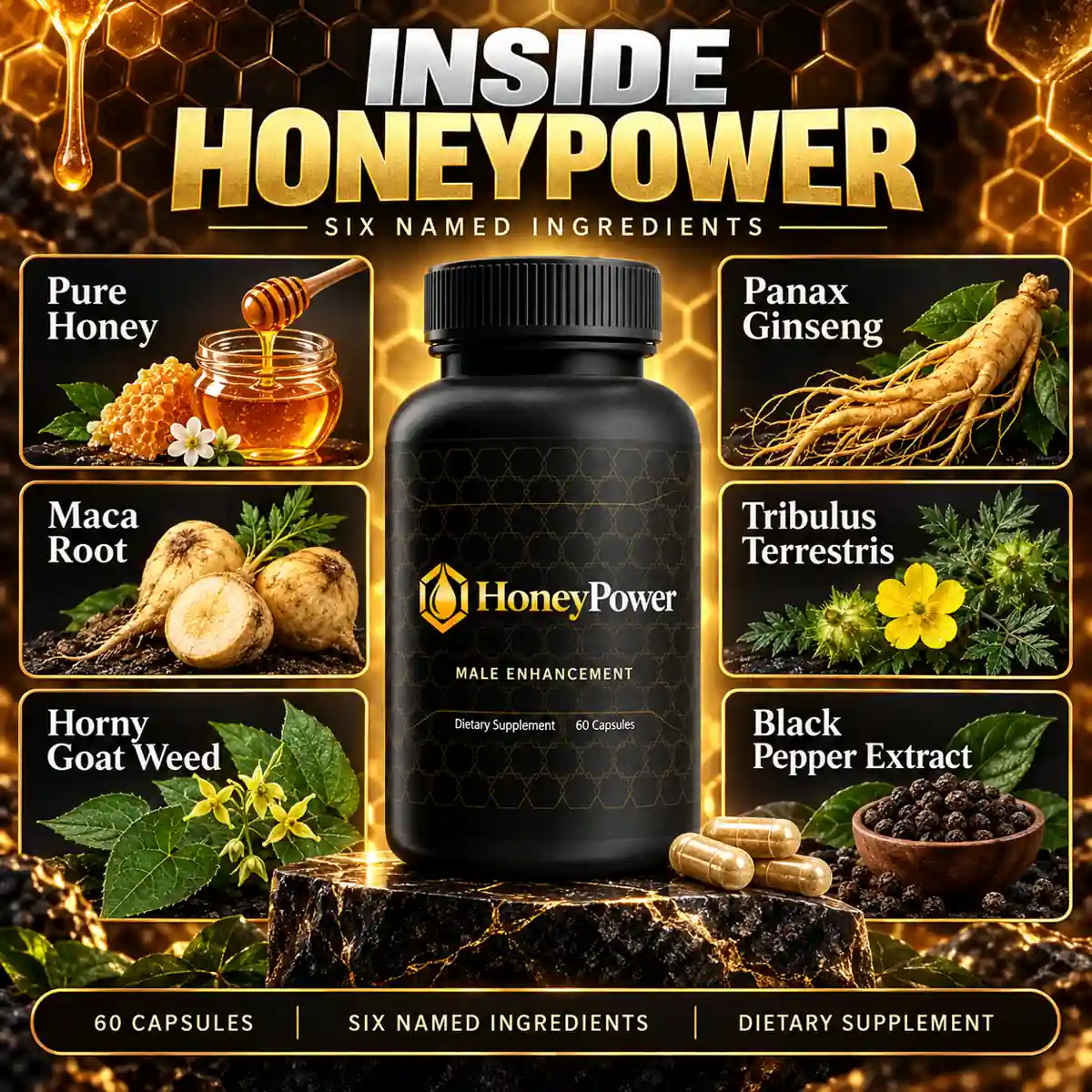
HoneyPower vs other supplements is best settled on the label, not on the claims. Run seven checks on any bottle: amounts, blends, plant part, trial doses, claim wording, reviewer and refund window. On these checks HoneyPower fails some, passes others, and we show both columns below.
- The most useful check is whether the label prints an amount for every ingredient. HoneyPower prints none.
- The claims on the overview panel are support claims, which is the ceiling for a supplement.
- The refund window is 180 days from purchase, empty bottles included.
- No certificate of analysis is published. A certificate reference is named, which is not the document.
- The badge row is the seller’s own artwork, not third-party certification.
- This post names no rival product. It gives you the method to compare any two.
How do you compare HoneyPower vs other supplements fairly?
To compare HoneyPower vs other supplements fairly, you compare what each label prints. That is the only fair ground, because claims are cheap and a label is a document. The site’s guide to choosing a supplement offers eight tests. We use seven here, and we run them on the HoneyPower bottle first.
This post names no other product. A comparison of HoneyPower vs other supplements needs a method more than it needs a rival, and the method works on any bottle you hold. Put the two labels side by side and score each line.
What are the 7 label checks?
- Is there an amount for every ingredient? Without it, no comparison with the research is possible, and no cost per gram can be worked out.
- Is there a proprietary blend? A blend gives one total weight for several ingredients, so the cheapest one can make up most of it.
- Does it name the plant part and the extract ratio? Root and leaf of one species are different ingredients. A 10:1 extract is ten times the material of a 1:1 at the same weight.
- Do the printed amounts match the trial doses? This is the test the first three make possible.
- What exactly is the claim? “Supports” is the ceiling for a supplement. A treatment claim is outside the rules.
- Is there a named, checkable reviewer? A byline counts only if you can find the person apart from the page.
- What is the refund window, and does it cover opened bottles? The trials measured at eight to twelve weeks. A 30-day window on unopened items makes a fair test impossible.
How does HoneyPower score on each check?
| Check | HoneyPower result | Why |
|---|---|---|
| Amount for every ingredient | Fails | No figure on any panel of the artwork, including the ingredient graphic |
| Proprietary blend | Not applicable | There is no panel at all, so there is no blend line |
| Plant part and extract ratio | Fails | Neither is stated for any of the six |
| Printed amounts vs trial doses | Cannot be run | One half of the comparison is empty |
| Claim wording | Passes | The nine benefit lines are structure and function statements |
| Named, checkable reviewer | Passes on this site | Pages name Dr. Shawn Blick, MD, Physician, with the About page |
| Refund window | Passes well | 180 days from purchase, empty bottles included |
From the choosing-a-supplement guide. We publish the fails next to the passes.
In a HoneyPower vs other supplements comparison, that is three fails, one that cannot be run, one not applicable and three passes. A seller who prints this about its own bottle is showing you where it stands.
If you want to apply the seven checks to the real bottle, the order page shows the packs and the 180-day guarantee.
See today’s price and guaranteeMyhoneypower is paid when you order through this button. The checkout shows the price that applies before you pay.
What does a HoneyPower vs other supplements comparison miss?
Three things are easy to lose. The first is the long ingredient list. More names on a panel usually means less of each, because a capsule holds a few hundred milligrams. The second is a citation with no dose attached. A trial of three grams a day does not support a capsule holding an unstated fraction of that.
The third is a test-tube result described as an effect. Icariin blocks an enzyme in glassware. The only human trial of isolated icariin ran open-label in a mood disorder and measured mood. HoneyPower names horny goat weed, and its amount is not published.
For scale, the trials behind the plants ran well into grams a day: ginseng 1,400 mg to 3 g, maca 1.5 to 3 g, tribulus 450 to 1,500 mg. Add the four plant powders at those doses and the total passes five grams a day before the honey. Two capsules carry all six. That is why the missing amounts matter.
Do badges and seals count in a comparison?
Only if a certifying body is named and a number is printed. The badge row on the overview panel says things like Made in the USA, GMP certified facility and no artificial colors, flavors or preservatives. These are the seller’s own artwork. No certifying body is named and no certificate number is printed, so none of them is a third-party certification.
The lot reference and the certificate reference on the pack are filing references, not laboratory proof. Our testing and quality page sets out what each mark claims.
Can you compare price per day across bottles?
Only when amounts are printed. Two dollars a day buys two capsules of a six-plant blend, and nobody outside the maker knows how the two capsules are split. Per serving, HoneyPower costs $2.30 on one bottle, $1.97 on three and $1.63 on six.
Those figures are checkable. The amount per dollar is not. A buyer who wants to compare cost per gram should choose a bottle with a panel on it. A buyer who wants to try this blend has a $69 entry price and a 180-day window. Our post on cost per day goes deeper. Start from the home page if you want the overview.
Frequently asked questions
How do I compare HoneyPower vs other supplements?
Put the labels side by side and run seven checks: amounts, blends, plant part, trial doses, claim wording, reviewer and refund window. Score each bottle on what it prints.
What is the most important line on a supplement label?
Whether it prints an amount for every ingredient. Without it you cannot compare the bottle with the research or with another bottle.
Does HoneyPower print an amount for each ingredient?
No. The artwork names six ingredients and prints an amount for none of them, so this site states no milligram figure.
Are the badges on the HoneyPower pack third-party certifications?
No. They are the seller’s own artwork. No certifying body is named and no certificate number is printed.
Does a long ingredient list mean a better supplement?
Usually the opposite. A capsule holds a few hundred milligrams, so every extra name means less of everything else.
What refund window should I look for?
One that outlasts the research. The trials measured at eight to twelve weeks. HoneyPower offers 180 days from purchase, empty bottles included.
Our view
Our view is that you should judge HoneyPower the way you would judge any bottle: by the label first. On that test it fails the amount and plant-part checks and passes on claims, reviewer and refund window.
That mixed result is honest, and it changes what you are buying. You are buying a maker’s judgement that you cannot check, with a long window to ask for the money back.
Not published: amounts, plant parts, extract ratios, a certificate of analysis and a trial of the finished capsule.
Run the checks on any bottle you are weighing, ours included. The price and guarantee are on the order page.
See today’s price and guaranteeMyhoneypower is paid when you order through this button. The checkout shows the price that applies before you pay.
Last updated . HoneyPower is a dietary supplement. It is not an FDA-approved product, and no supplement is. It is not meant to diagnose, treat, cure or prevent any disease. See a doctor about any medical concern.
- An analysis of the best-selling testosterone boosters: pubmed.ncbi.nlm.nih.gov/30770069
- An evidence-based review of ingredients in male supplements: pubmed.ncbi.nlm.nih.gov/32358510
- A urologist's guide to what is in men's sexual-health products: pubmed.ncbi.nlm.nih.gov/26531010
- A 2026 paper on the gap between an ingredient list and what a buyer reads into it: pubmed.ncbi.nlm.nih.gov/42660500